Introduction: The "Mango Tree" Directions of the Digital World
If you have lived in Zambia long enough, you know exactly how giving physical directions used to work.
"Drive down Great East Road, turn left at the big mango tree, go past the car wash where the guys are wearing yellow overalls, and it’s the third blue gate on the right. If you see a barking dog, you have gone too far."
While that might work for finding a friend's weekend braai, it is an absolute disaster for running a modern business. Yet, in 2026, many entrepreneurs treat their digital presence exactly the same way.
Customers are tired, and attention spans are shorter than a load-shedding schedule in November. If you want to be taken seriously, your business needs a dedicated digital home.
But throwing a few pictures on a page and calling it a day won't cut it anymore. If you are looking for a website developer for small business in Zambia, you need to ensure they are building a machine that actually works for you, not just a digital flyer.
Whether you run a fast-growing logistics company in Ndola, a boutique in East Park Mall, or an accounting firm in Kitwe, here is the ultimate anatomy of a high-converting small business website in Zambia. These are the 10 non-negotiable features you need in 2026.
1. The 5-Second Homepage Test (Clear Value Proposition)
When a potential client lands on your homepage, you have exactly five seconds to answer three critical questions in their head:
What exactly do you do?
Where are you located?
How does this solve my problem?
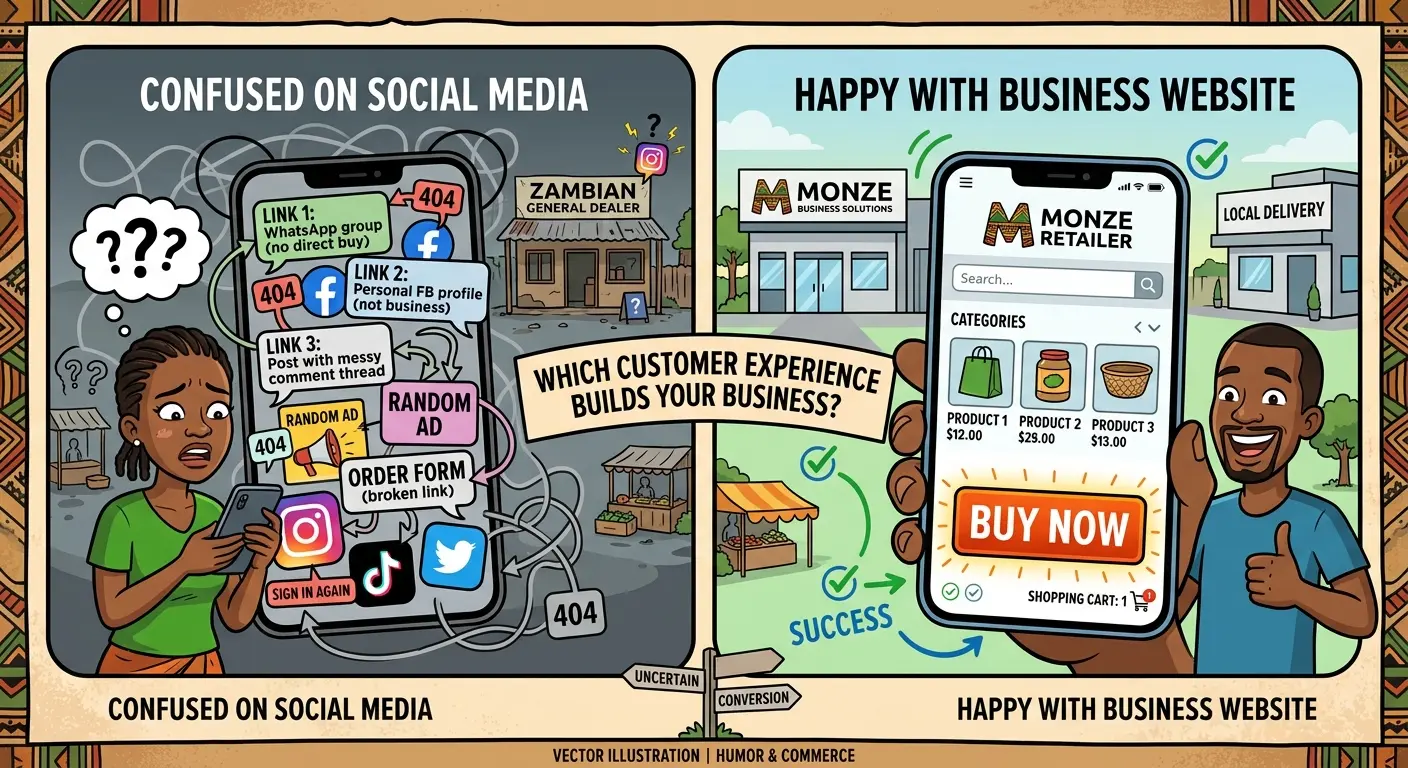
If they have to scroll down to the bottom of the page just to figure out if you sell solar panels or if you install them, they are going to leave and click on your competitor's link.
Your homepage needs a powerful, clear "Hero Section" (the very top part of the website). It should feature a bold headline, a brief sub-headline, and a clear call to action.
Bad Example: "Welcome to Phiri & Sons. Excellence is our habit." (This means nothing. Excellence in what? Baking bread? Fixing tractors?)
Good Example: "Reliable Solar Installation Services in Lusaka. Keep your business running 24/7 with our affordable corporate solar setups."
2. Ruthless Mobile Optimization (The Minibus Rule)
Let’s be realistic. The vast majority of your target audience will not be sitting in a Herman Miller chair looking at a 27-inch iMac screen. They will be sitting in the back of a Rosa minibus on their way to town, holding an Android phone with one hand.
If your website layout breaks on a small screen, if the text is so tiny they have to pinch and zoom, or if your buttons are too close together for a normal-sized thumb to click accurately, you are losing money.
Any reliable web designer in Lusaka for small business will tell you that mobile optimization is no longer an "extra feature." It is the absolute core of business website development Zambia. Google even ranks mobile-friendly websites higher than desktop-only ones.
3. The "Anti-Ghosting" Contact Page
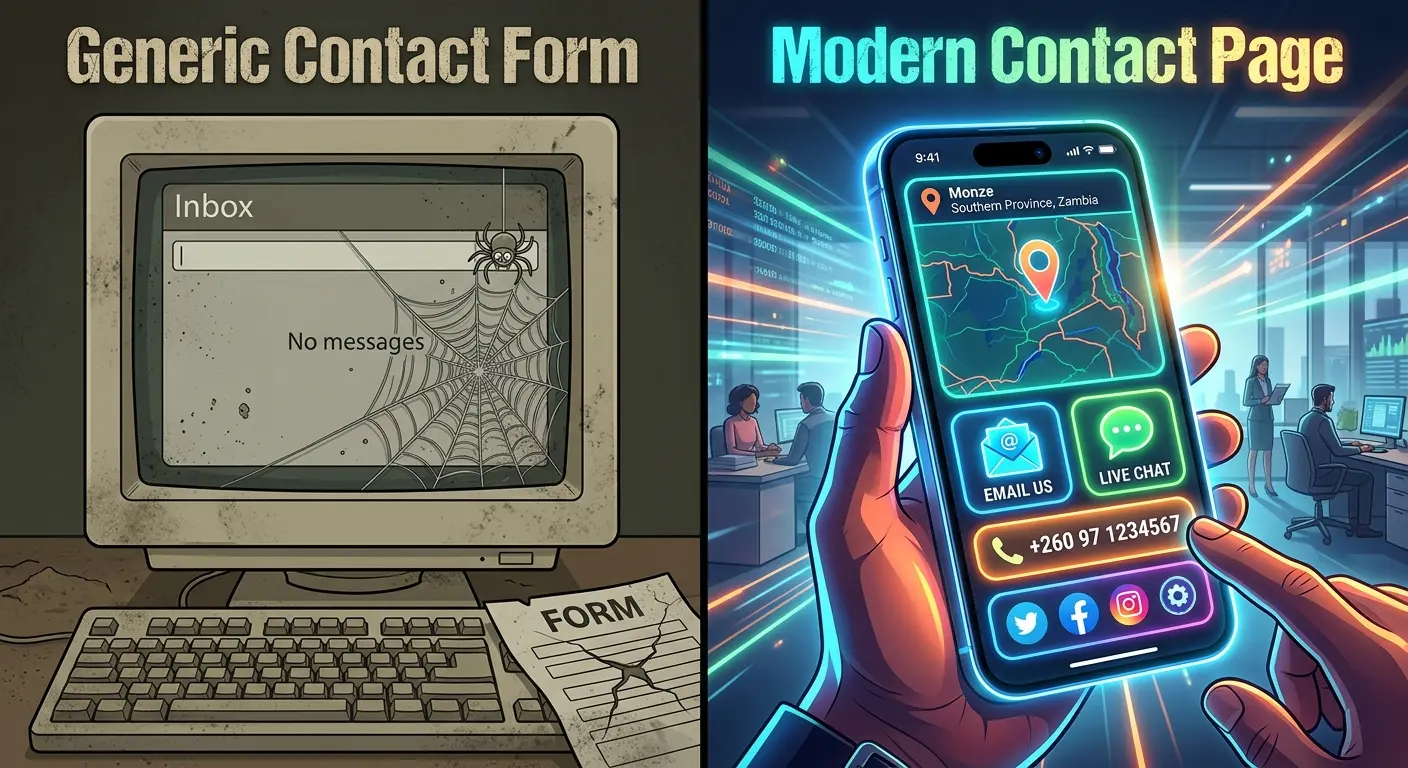
Have you ever tried to hire a service, gone to their contact page, and only found a generic form that asks for your life history, blood type, and mother's maiden name? You fill it out, hit "Submit," and it disappears into the void. Nobody ever replies.
Zambian consumers are highly relational. They want to know there is a real human being on the other side of the screen. Your contact page must include:
A direct phone number (clickable from mobile).
A professional email address (e.g., hello@yourbusiness.co.zm, not sweetboy_john99@gmail.com).
Your physical address with an embedded interactive Google Map.
Your operating hours (so people know not to call you at 2:00 AM on a Sunday).
4. Transparent Services and Pricing (End the "DM for Price" Madness)
If there is one thing that unites all Zambian internet users, it is a deep, passionate hatred for the phrase, "Check your inbox" or "DM for price."
Your website is your 24/7 digital salesperson. Its job is to filter out people who can't afford you and attract the people who can. When you hide your basic service packages or starting prices, you create unnecessary friction.
You don't have to list every single custom quote, but you should absolutely have a dedicated "Services" page that clearly outlines:
What you offer.
Who it is for.
A baseline cost (e.g., "Basic consultations start at K500").
Transparency builds immediate trust. When a customer knows your price range upfront, the leads you do get will be much higher quality because they are already financially qualified.
4. Direct WhatsApp Integration
We cannot talk about doing business in Zambia without talking about WhatsApp. It is the lifeblood of corporate and casual communication.
While a professional email setup is mandatory for corporate contracts, many of your fast-moving clients just want to ask a quick question. Having a floating WhatsApp chat button in the bottom corner of your website bridges the gap between formal web browsing and instant, familiar communication.
When users click that button, it should seamlessly open their WhatsApp app with a pre-filled message like: "Hello, I am interested in your services from your website. Can we talk?" It is the easiest way to turn a casual browser into an active lead.
6. Trust Signals and Local Reviews
Zambians are naturally skeptical buyers. We have all been burned by someone who promised to deliver a high-quality product and instead delivered something that looked like it survived a warzone.
Because of this, word-of-mouth is everything. Your website needs to digitize that word-of-mouth through Trust Signals.
These include:
Client Testimonials: Real quotes from real people. (Bonus points if you include their name and company).
Case Studies/Portfolios: Don't just say you are a great landscaper; show high-quality before-and-after photos of the gardens you have transformed in Kabulonga or Riverside.
Partner Logos: If you have worked with reputable local brands, display their logos proudly. It tells new visitors, "If the big guys trust us, you can too."
7. Blistering Load Speeds (Surviving 3G and Load Shedding)
Imagine this: your potential customer is running on a backup inverter, their fiber internet is down, and they are using their mobile hotspot on a congested 3G network. They tap your website link.
If they have to stare at a blank white screen for 12 seconds because your website is loaded with massive, uncompressed 10MB images of your office building, they are going to hit the "back" button and never return.
Speed is not just a luxury; it is a conversion metric. Your website developer for small business in Zambia must prioritize lightweight coding, image compression, and high-quality local or cloud hosting. A modern site should ideally become fully readable in under 3 seconds.
8. Local SEO Fundamentals
What is the point of having a beautiful digital storefront if nobody can find it?
Search Engine Optimization (SEO) ensures that when someone in your city Googles your services, your business actually shows up on the first page. For a small business website, this means mastering Local SEO.
Your website must include:
A .co.zm Domain: This tells Google instantly that you are a Zambian business serving a local market, which gives you a massive advantage in local search rankings.
Localized Keywords: Using phrases naturally in your text, like "expert accountants in Lusaka" rather than just "expert accountants."
Google Business Profile Integration: Your website should link directly to your Google Business Profile (Google Maps), establishing a closed-loop of local authority.
9. An "About Us" Page That Actually Tells a Story
Most "About Us" pages read like they were written by a robot reading a corporate dictionary. "We are a synergy-driven paradigm of excellence providing multifaceted solutions." Yawn.
People do business with people they like and relate to. Your About page is your chance to humanize your brand.
Tell the story of why you started the business.
Introduce the founders or the core team with friendly, professional photos.
Share your core values in plain, conversational English.
If you are a family-owned bakery that started in your grandmother's kitchen in Chilenje and grew into a commercial operation, tell that story! It builds an emotional connection that a corporate buzzword never could.
10. A Clear, Unavoidable Call to Action (CTA)
Finally, do not leave your visitors guessing about what they are supposed to do next. You have given them the information, you have built the trust, and the site is loading fast. Now what?
Every single page on your website should guide the user toward a specific action. This is called a Call to Action (CTA).
Are you a consultant? Your CTA should be a bold button saying: "Book a Free Consultation."
Are you a cleaning service? Your CTA should be: "Get a Free Quote Today."
Do you sell physical products? Your CTA should be: "Browse Our Catalog."
Make these buttons stand out with contrasting colors. Don't make people search for a way to give you their money.
Ready to Build Your Digital Sales Machine?
Building a small business website in Zambia is not about just throwing a digital brochure onto the internet. It is about engineering a 24/7 digital asset that answers questions, builds authority, and actively generates leads while you sleep (or while you are stuck in traffic on Kafue Road).
If your current website is missing half of these features, or if you are still relying entirely on a Facebook page to run your business, it is time to upgrade.
Stop settling for the digital equivalent of "turn left at the big mango tree." Let's build a professional platform that sets you apart from the competition.