Introduction: The Great Zambian Web Quote Mystery
Imagine you want to buy a Toyota Mark X. You walk around the car dealers at the border or scroll through Be Forward, and you have a general idea of the price. It makes sense.
But when you text five different people in Lusaka asking, "How much to build a website for my business?" the replies will make your head spin faster than mini-bus drivers overtaking on Great East Road.
Developer 1 (Your cousin’s friend who does IT at a local college): "Big boss, just send me K1,500 and a pack of Hungry Lion. I'll finish it by Saturday."
Developer 2 (A serious-looking freelancer on LinkedIn): "That will be K12,500, sir. Half down-payment before I buy domain."
Developer 3 (A high-end boutique digital agency in Rhodes Park): "Our custom web development services in Zambia start at K65,000, exclusive of VAT."
Why is there such a massive gap? Are the agency guys trying to buy a plot in Chongwe with your single project, or is the K1,500 guy planning to run away with your talk-time?
Let’s lift the curtain and break down the real cost of website development in Zambia in 2026 so you can budget properly without getting gong'ed (cheated).
The Real Cost Breakdown by Website Type
The single biggest factor dictating your invoice is what you actually need the website to do. If it’s just a digital business card, it shouldn't cost you an arm and a leg. But if it’s a fully operational machine, well, quality engineering takes resources.
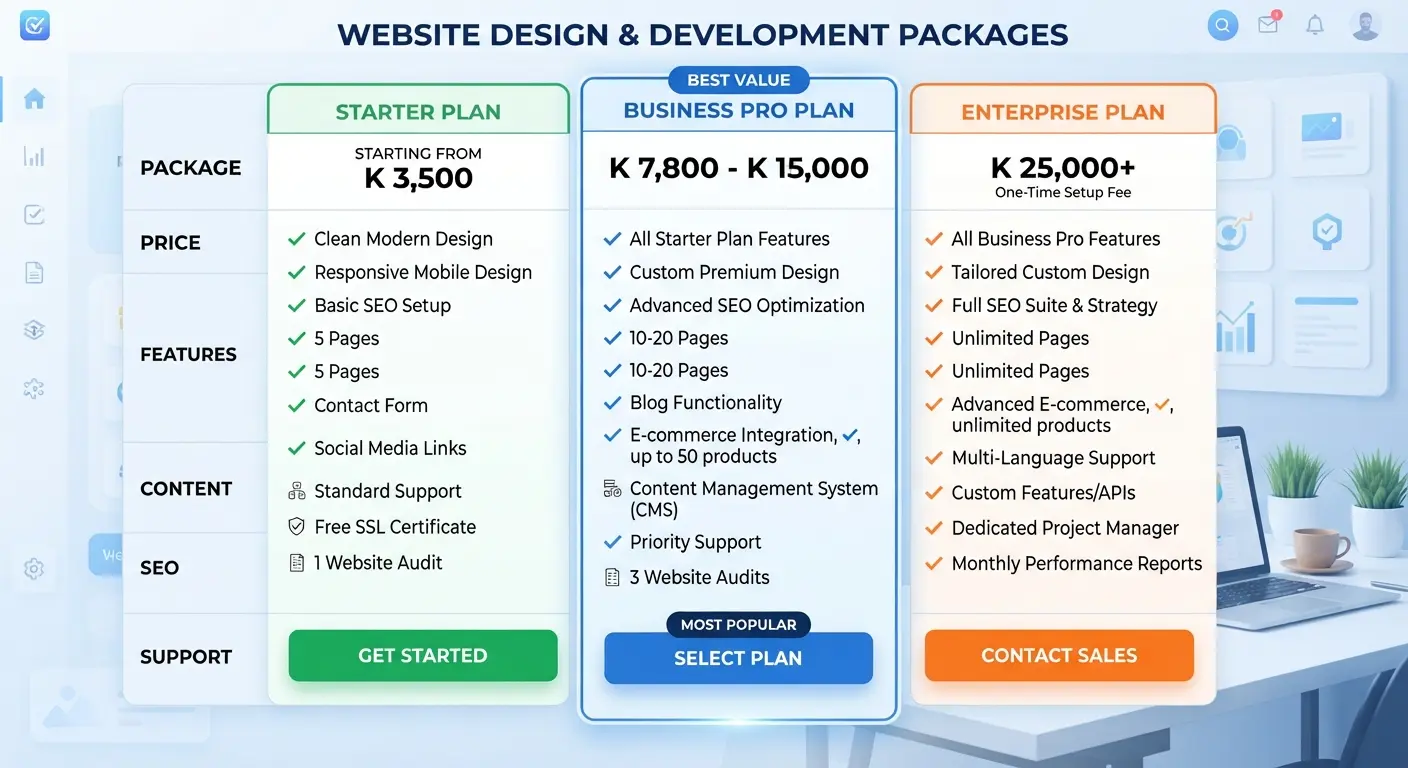
A. The Basic "Brochure" Website (K3,000 – K6,000)
This is a standard informational site. It usually features 3 to 5 pages: Home, About Us, Our Services, and a Contact page with a map and a form. It’s built using a clean template, usually on WordPress.
Who it’s for: Clearing agents, local clinics, small consultancies, or safari lodges just getting started.
What’s included: Standard layout, mobile compatibility, and a basic contact form.
The Catch: If you want custom fancy animations or 50 different sub-pages for every single service you offer, this budget will burst.
B. The Corporate Business Website (K7,500 – K18,000)
This is where professional website design in Zambia truly shines. These sites are custom-tailored to represent an established brand. They feature advanced functionalities like booking systems, file downloads, careers portals, or multi-tiered service structures.
Who it’s for: Law firms, microfinance institutions, construction companies, and growing NGOs.
What’s included: Custom UI/UX layout design, content management system (so you can edit text yourself), advanced security layers, and on-page SEO optimization.
C. The E-commerce Powerhouse (K15,000 – K35,000+)
An ecommerce website in Zambia is not just a bunch of pretty pictures. It is a live digital store that connects directly to local payment processors. It requires highly secure user accounts, automated stock tracking, shipping calculators, and an easy checkout system.
Who it’s for: Supermarkets, boutique fashion brands, electronics retailers, and agricultural suppliers.
What’s included: Payment gateway integrations (Airtel Money, MTN Mobile Money, Zamtel, and Visa/Mastercard), inventory management dashboard, and secure SSL encryption.
Hidden "Under-the-Hood" Annual Costs
When you build a website, the initial design fee is just one part of the story. A website is like a physical office shop—you have to pay annual ground rent and keep the lights on. If a developer doesn't explain these recurring fees to you, you are in for an awkward surprise twelve months later.
Here are the standard annual fees you must budget for:
Domain Name Registration (.com vs .co.zm)
Your domain is your internet address (e.g., yourcompany.com).
A standard .com domain usually costs around K300 to K500 per year.
A local .co.zm domain managed through ZAMNET costs roughly K800 to K1,000 per year. Using a .co.zm domain is fantastic for local SEO because it tells Google explicitly that you serve the Zambian market.
Web Hosting Space
Hosting is the digital plot of land where your website's files live. Without it, your site cannot stay live on the internet.
Basic Shared Hosting: Good for small business sites, costing around K500 to K2,000 per year.
VPS / Cloud Hosting: Mandatory for busy e-commerce platforms and web apps that cannot afford to go offline when traffic spikes. This ranges from K3,500 to K10,000+ per year.
SSL Certificates (The Security Padlock)
You know that little lock icon next to a website address in your browser? That's an SSL certificate. It ensures nobody can intercept private messages or payment details on your site. Many reputable hosting companies include a basic Let's Encrypt SSL for free, but some developers will try to charge you an extra K1,000 for it. Make sure to ask upfront!
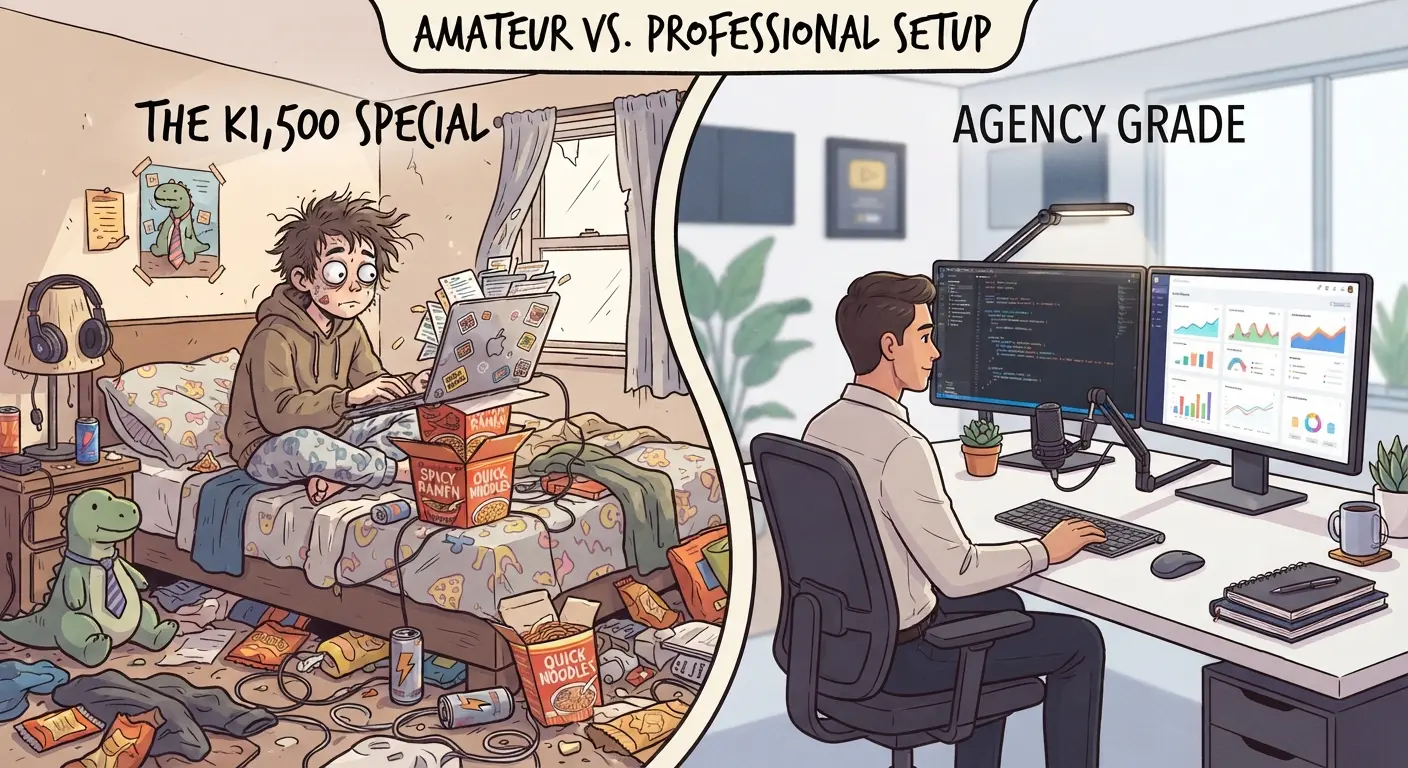
Why Can You Find a Website for K1,500? (The "Junior" Danger)
We have to talk about "Junior." Every family or office network in Zambia has a Junior. He is a nice guy, loves video games, "knows computers," and can bypass almost any office Wi-Fi password. Naturally, people assume he can build business-grade websites.
Hiring an amateur to build your business website for K1,500 is tempting, but here is what usually happens behind the scenes:
The Ghost Act: Junior gets excited, takes your 50% deposit, and buys a nice pair of sneakers. Then his college exams start, or load shedding hits his neighborhood for 12 hours straight. Suddenly, his phone is "not reachable" for three weeks.
The Template Trap: Amateurs often buy a cheap, cracked website template from the internet. These templates are frequently infected with hidden malware. Six months down the line, your corporate website starts redirecting your clients to sketchy betting or adult dating sites.
Zero Mobile Optimization: They will build a site that looks okay on their wide computer screen, but when a client tries to open it on an ITEL or Samsung phone while riding in a minibus, the text overlaps, the buttons disappear, and the user closes the tab in frustration.
When you invest in professional web development services in Zambia, you aren’t just paying someone to type code. You are paying for project management, reliability, data security, and a digital asset that actually functions under poor network conditions.
Frequently Asked Questions (FAQs)
Q1: Why do e-commerce websites cost so much more than normal sites?
Because an e-commerce site handles money and databases. Integrating local mobile money APIs (like MTN and Airtel via aggregators like DPO or Flutterwave) requires secure webhooks and custom development logic. If an informational site glitches, a page doesn't open. If an e-commerce site glitches, a customer loses K5,000 and you lose a customer for life. Security and complex workflows cost money.
Q2: Can I pay for my website development in installments?
Yes, almost all professional developers and web design agencies in Zambia operate on an installment structure. The standard industry practice is a 50% deposit to initiate the project, and the remaining 50% upon successful testing and launch. Be wary of anyone demanding 100% upfront payment before touching a line of code.
Q3: Does the development price include writing the text and taking photos?
Usually, no. Most web developers expect you to provide your business profile, logos, product photos, and text. If you want the agency to write your content or hire a professional photographer to visit your warehouse in Indeco, they will add a "Content Creation" fee to your quote.
Q4: How can I tell if a quote is a rip-off or fair?
Always ask for a detailed breakdown. A fair quote will clearly list the costs for: UI Design, Front-end development, Domain registration, Hosting space, and Post-launch support. If a quote just says "Website - K20,000" with no explanation, ask them to show their working!
Stop Guessing. Get a Clear, Fixed Quote Today.
Your business deserves better than a broken template or a website that remains "Under Construction" until next year. Invest in an online storefront that builds trust, commands authority, and drives real revenue into your bank account.
Let's discuss your project goals, cut out the confusing tech jargon, and give you a transparent breakdown that fits your business scale.