Introduction: The "Boss, Trust Me" Trap
If you throw a stone down Great East Road or Cairo Road in Lusaka, chances are high you’ll hit someone who claims they can build you a website.
Open any WhatsApp business group, Facebook Marketplace, or LinkedIn, and you’ll see dozens of profiles screaming: "Affordable websites! Cheapest web developer in Lusaka! Corporate packages for K1,500!"
When you slide into their DMs to ask for more information, the answer is always the same: "Boss, trust me. I can do it. Just send a 70% deposit via Mobile Money so I can buy data and start hosting."
Fast forward three months, and that "trust me" has turned into a massive headache. The website is half-done, it looks completely different from what you discussed, your logo is stretched out like a piece of chewing gum, and the developer has gone entirely ghost because they found a full-time job or their phone got stolen.
Choosing a provider for web development services in Zambia shouldn't be a game of lucky dip. Your website is your digital flagship storefront. If you hire the wrong person, you aren’t just losing money—you are giving your competitors a massive head start.
Let’s look at how to vet local professionals like a seasoned corporate executive so you can hire the right team the first time.
The Portfolio Check: Look Beyond the Screenshots
The absolute first rule of hiring a web professional is simple: Show me, don't tell me.
If a developer sends you a beautiful PDF proposal full of pristine, high-resolution screenshots of websites they claim to have built, do not just nod and smile. Screenshots can easily be stolen from global design sites like Dribbble or Behance.
Demand live, clickable URLs of websites they have deployed for other Zambian businesses. Once you get those links, do a quick investigation:
Click the links on your phone: Over 80% of your customers are browsing on mobile devices. If their portfolio sites look completely broken, unaligned, or slow on an ordinary phone connection, walk away. They don't understand modern responsive web design.
Check the footer: Scroll to the very bottom of their client's homepage. Does it say "Website designed by [Company Name]"? If it doesn't, or if it points to a completely different agency, ask them to explain exactly what role they played in that project.
Look for local relevance: Have they built projects that manage real workflows? If you need a complex enterprise application, look for a team that has a track record in solid software development in Zambia. If they’ve only ever customized basic blogs, they might lack the engineering muscle your project requires.
Agency vs. Freelancer: Which One Fits Your Scale?
Neither option is inherently bad, but they serve completely different business needs and budgets. You need to know exactly what trade-offs you are making.
Feature | The Independent Freelancer | The Professional Digital Agency |
|---|---|---|
Typical Cost | Lower (K3,000 – K10,000) | Higher (K15,000 – K50,000+) |
Skillset | Jack-of-all-trades. One person trying to do design, coding, copywriting, and project management. | Dedicated specialists. Separate graphic designers, software engineers, SEO experts, and project managers. |
Reliability | Risky. If they get sick, face an electricity blackout, or have personal issues, your project halts instantly. | Highly secure. They have backup systems, dedicated office spaces, team redundancy, and legally binding contracts. |
Best For | Early-stage startups, tiny retail shops, or personal blogs with highly flexible timelines. | Established businesses, corporate brands, NGOs, and custom e-commerce applications. |
If you are a large logistics firm or a financial institution, trying to save money by using an unvetted freelancer is a recipe for disaster. If your site goes offline for two days, you’ll lose far more money in lost leads than what you "saved" on development fees.
Four Critical Technical Questions to Ask Before Signing
When you sit down with a prospective web developer in Lusaka, don't just talk about colors and fonts. Throw these four technical diagnostic questions at them to see if they are a real professional or an amateur winging it:
Question A: "Will the website be registered under my own name and accounts?"
A classic scam among rogue developers is registering your domain name (e.g., yourfirm.com) and your cloud hosting under their personal email and credit card.
If you ever want to switch developers or part ways down the road, they will hold your entire digital brand hostage and demand an exorbitant "release fee."
Ensure all accounts are registered in your name from day one.
Question B: "What Content Management System (CMS) do you use?"
If they answer, "I will build a custom CMS completely from scratch that only I know how to edit," red alert! This is a trap designed to make you completely dependent on them forever. Ensure they build on open-source platforms like WordPress or widely adopted modern frameworks. This ensures that if they relocate to the UK tomorrow, another developer can easily step in and update your code.
Question C: "Does your quote include basic security and on-page SEO?"
Some developers will quote you a phenomenally low price, only to slap you with extra hidden charges later for essential things like an SSL certificate (the secure browser padlock) or setting up your meta tags so Google can read your site. A professional quote for website design in Zambia should explicitly include core security architecture and baseline visibility standards.
Question D: "What happens if the website breaks after launch?"
A website is not a set-it-and-forget-it asset. It’s software. Plugins need updates, hosting servers require maintenance, and occasionally things break. Ask them clearly about their post-launch support and SLA (Service Level Agreement) packages.
Frequently Asked Questions (FAQs)
Q1: Is it better to choose an international agency or a local Zambian company?
While international agencies have massive teams, choosing a local company means they genuinely understand the Zambian landscape. They know how to optimize sites for slower local networks, they understand local consumer psychology, and they can seamlessly integrate local mobile money payment gateways like Airtel, MTN, and Zamtel. Plus, you can actually visit their office if you need to talk face-to-face.
Q2: How can I protect my business legally when hiring a developer?
Never kick off a project based solely on a verbal agreement or a basic WhatsApp chat. Always demand a signed contract that clearly specifies the Scope of Work (SOW), a clear schedule of deliverables, exact milestone deadlines, a structured payment plan, and clear statements regarding intellectual property ownership.
Q3: Why do some agencies take 6 weeks while a freelancer promises it in 5 days?
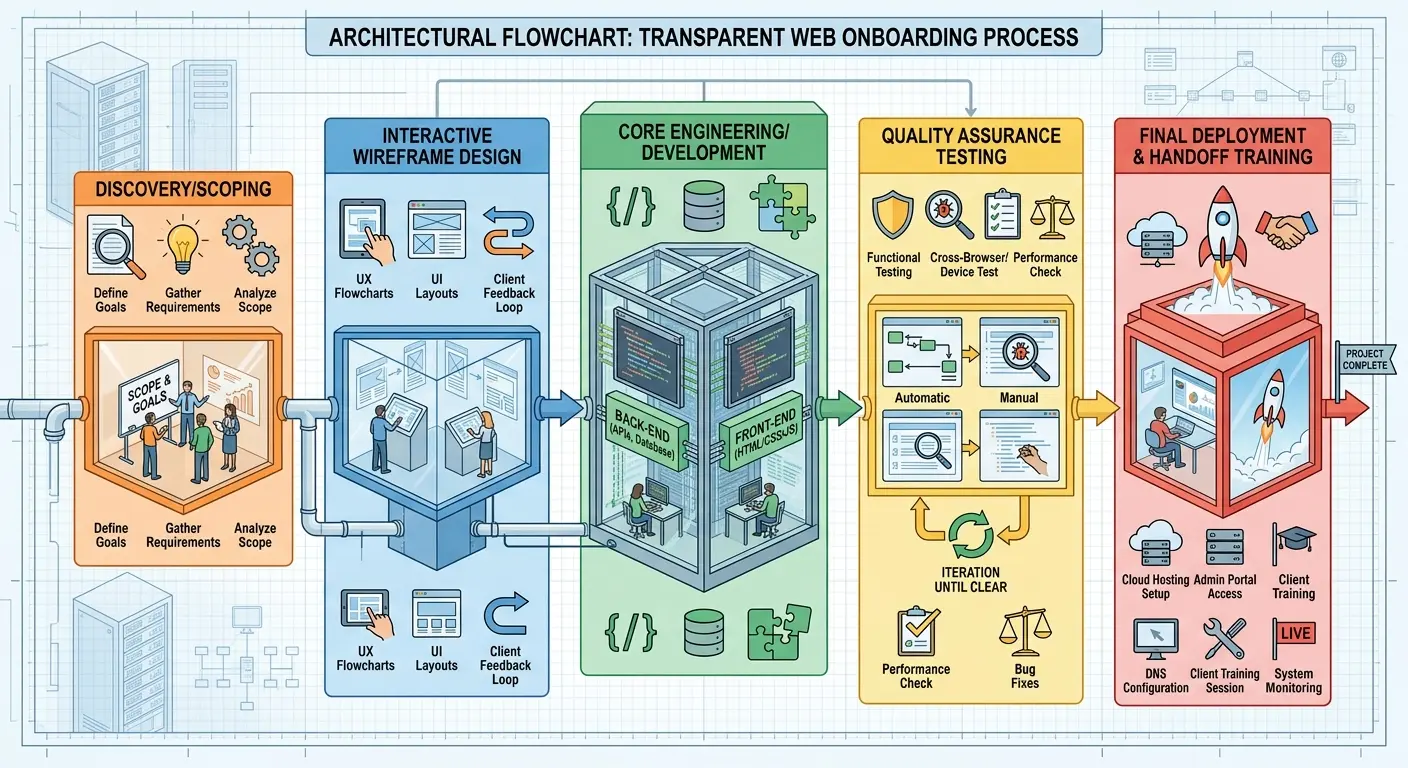
An agency uses a structured phase approach: researching your users, designing unique mockups, doing security code reviews, and executing multi-device quality testing. A freelancer promising a site in 5 days is almost certainly just installing a pre-made, generic internet template, swapping out the logo, pasting in your text, and skipping all security hardening and optimization steps.
Q4: Can I change my web hosting provider later if I'm unhappy with my developer?
Yes, absolutely—provided you have full administrative access to your domain registration panel and hosting backend. This is why ensuring absolute ownership of your digital credentials during the initial setup phase is non-negotiable.
Hire a Partner, Not Just a Coder
Your business doesn’t just need someone who can write lines of code; it needs a digital partner that understands business strategy, brand presentation, and conversion optimization.
Stop playing Russian roulette with your digital marketing budget. Let's build a secure, world-class corporate platform that commands respect and drives measurable growth for your business.