Introduction: From Backyard Hustle to Legitimate Corporate Entity
Picture this: You have spent months refining your business idea, building a loyal base of early clients through WhatsApp and word-of-mouth, and saving up capital to scale. You finally land a meeting to pitch your services to a major corporate enterprise or a government parastatal in Lusaka.
The meeting goes brilliantly. The directors look at you and say, "We love your proposal. Send over your formal corporate profile, your PACRA certificate of incorporation, your tax clearance certificate, and your business bank account details, and we will issue the purchase order."
You freeze. Your stomach drops.
You realize you have been running your entire enterprise as an informal hustle. You don't have a registered corporate entity, you don't have a corporate bank account, and you can't sign formal B2B contracts. In one swift moment, a massive business opportunity slips through your fingers simply because your business paperwork wasn't in order.
Operating informally might work when you are starting out, but if you want to scale, win corporate contracts, secure business bank financing, and protect your personal liability, you need to legitimize your venture.
Let's walk through the exact, up-to-date process of how to register a company in Zambia through the Patents and Companies Registration Agency (PACRA) and the electronic ZamPortal system.

Step 1: Business Name vs. Limited Liability Company (Know the Difference)
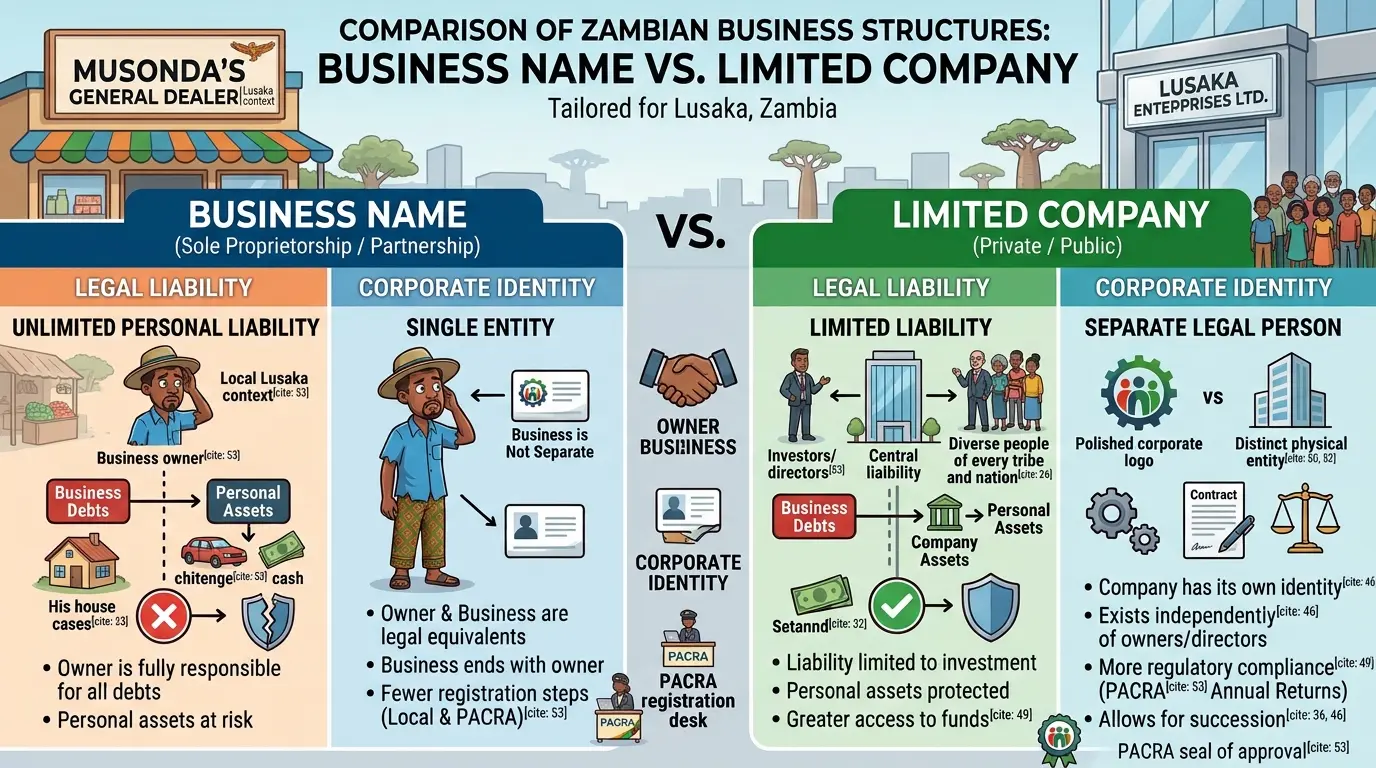
Before you touch any application forms, you need to decide what legal structure fits your goals. Many entrepreneurs confuse a simple "Business Name" with a "Limited Company," but they operate under completely different legal rules:
Business Name (Sole Proprietorship / Partnership): This registers the trading name under which you operate. However, a business name has no separate legal personality. This means your personal liability is unlimited—if your business faces a lawsuit or debt, your personal assets (like your car or home) are at risk. It is cheap and fast to register, but it lacks corporate prestige.
Limited Liability Company (Private Limited): A company is a distinct body corporate—an artificial legal person separate from you as an individual. It can own property, sue, or be sued in its own name. Most importantly, your financial liability is limited to the value of your shares, protecting your personal assets. It has perpetual succession (meaning the business survives even if ownership changes or founders pass away).
If you want to build a scalable business, bid for corporate tenders, and open dedicated corporate bank accounts, registering a Local Private Limited Company is almost always the right choice.
Step 2: Name Clearance and Reservation (The First Official Hurdle)
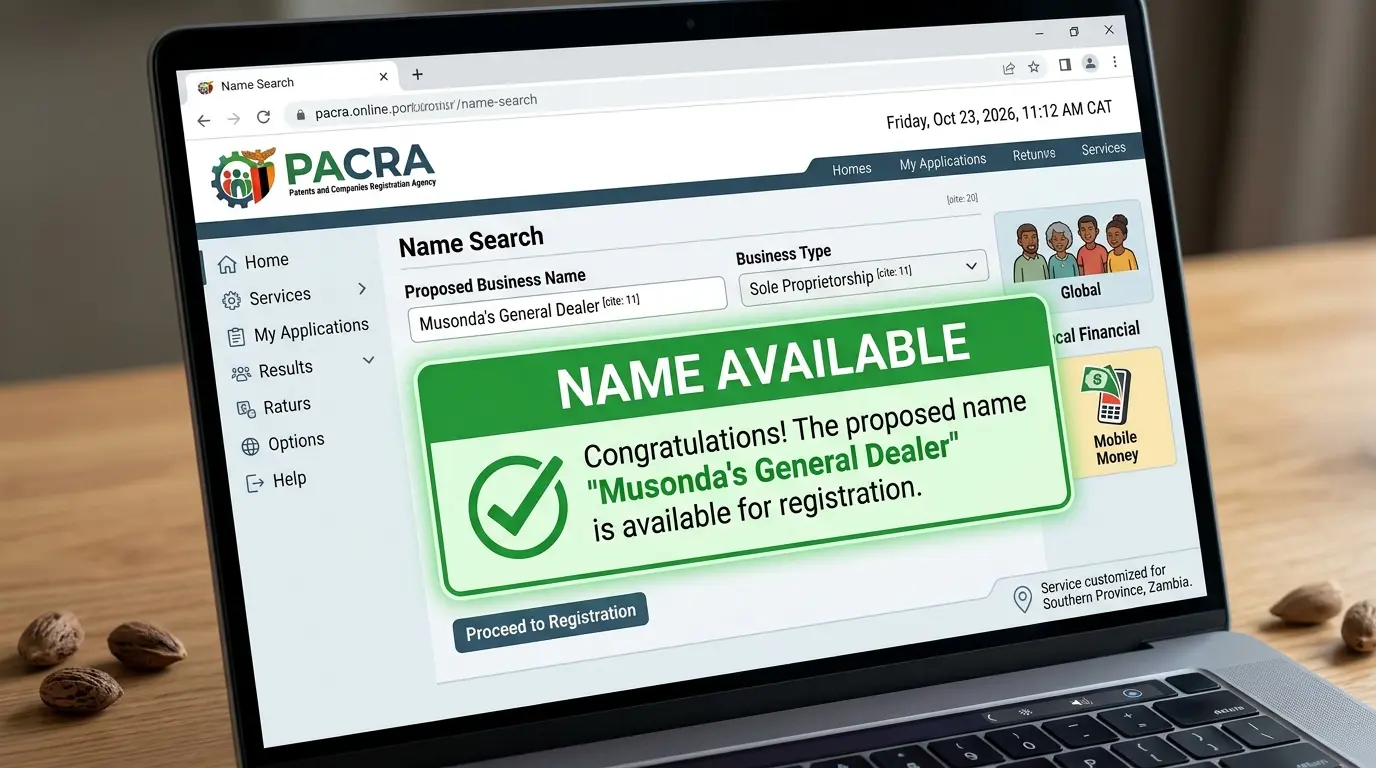
You cannot just pick any name that sounds cool; your company name must be unique and approved by PACRA.
Prepare Three Name Options: When applying, you will be required to submit up to three proposed names in order of preference, just in case your first choice is already taken or too similar to an existing registered entity.
Submit Name Clearance: You can apply for name clearance online via the official PACRA Portal (portal.pacra.org.zm) or through the government’s centralized ZamPortal (zamportal.gov.zm).
Pay the Clearance Fee: The official fee for a company name clearance form (Companies Form 1) is K120.00.
Validity Window: Once approved, an approved name is valid for registration for 30 days. You can choose to reserve it for a further 90 days if needed, but if an approved name expires without action, you have to reapply.
Step 3: Preparing Your Incorporation Documents
Once your company name is cleared, you can proceed to the incorporation stage (Companies Form 3). To complete your application smoothly, make sure you have the following information and documents ready:
Registered Office Address: A physical street address in Zambia where official notices and correspondence can be sent (Plot number, street name, town/city).
Director and Shareholder Details: Full legal names, residential addresses, email contacts, and clear copies of national registration cards (NRCs) for Zambian citizens or valid passports for foreign nationals. Every private company must have at least one director.
Share Capital Structure: You will need to define how many shares your company is authorizing and how those shares are divided among the founding shareholders.
Articles of Association: The internal rulebook governing how your company will be managed, how meetings are held, and how directors exercise their powers.
Step 4: Submission and Payment via ZamPortal or PACRA Portal
Gone are the days when you had to queue for hours at PACRA offices with physical paper files and cash. Today, the entire system is digitized:
Create or log into your account on the PACRA Portal or ZamPortal.
Complete the online Companies Form 3 (Application For Incorporation).
Upload scanned copies of the required shareholder IDs and documents.
Pay the statutory incorporation fees securely online (incorporation fees start from K1,266.67, depending on your authorized share capital structure).
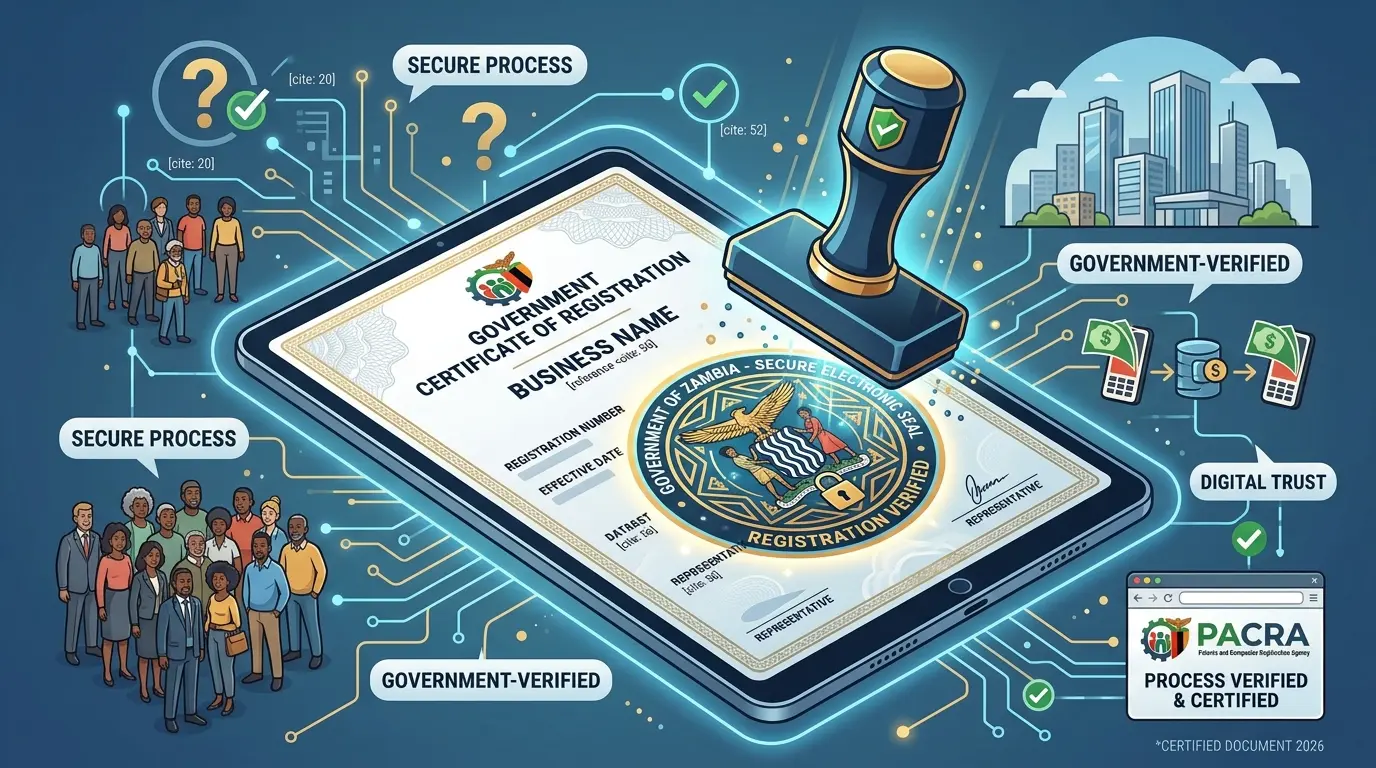
Once processed and approved by the registrar, you will receive your official Certificate of Incorporation and your company’s unique registration number digitally.
Step 5: Post-Incorporation Essentials (What to Do Next)
Receiving your PACRA certificate is a massive milestone, but your legal setup doesn't end there. To operate fully and legally in Zambia, you immediately need to handle three crucial post-incorporation steps:
1. Register for Taxes with ZRA (Zambia Revenue Authority)
Within 30 days of incorporation, your company must register with the ZRA to obtain a Taxpayer Identification Number (TIN). You will also need to register for relevant taxes depending on your business model, such as Turnover Tax, Value Added Tax (VAT), and Pay As You Earn (PAYE) if you plan on hiring employees.
2. Open a Corporate Bank Account
Take your Certificate of Incorporation, PACRA printouts, ZRA TIN certificate, and proof of your registered office address to a commercial bank in Zambia to open a dedicated Corporate Bank Account. Never mix personal funds with business revenue; keeping clean corporate financial records is vital for tax compliance and future business growth.
3. Maintain Annual Returns
PACRA requires all registered companies to file their Annual Returns on time every year. Failing to file annual returns for extended periods can flag your company as dormant, leading to penalties or even deregistration.
Lay the Right Legal Foundation for Growth
Registering your company is the first concrete step toward building a sustainable, scalable business enterprise in Zambia. It shifts your venture from an informal project into a respected corporate entity ready to sign contracts, hire staff, and attract serious investment.
Once your company is legally registered and your corporate identity is locked down, your next priority is building your digital footprint so clients can find you. Read my guide on How to Get Your Business Website on Google in Zambia (And Actually Stay There in 2026) to start driving organic search traffic to your newly legitimized brand.
Or, if you want to ensure your operations are visible to local customers right away, review my guide on Local SEO in Zambia: How to Get Found by Customers Right Next Door to dominate Google Maps.
Stop operating in the shadows. Formalize your business, build your digital infrastructure, and position your company for long-term success.
Ready to take your business online after registration? Contact us today to build a high-performing corporate website that matches your new legal status!