If you ask ten randomly selected people on the streets of Lusaka or Kitwe about the state of the Zambian industry, you’ll likely get a mixed bag of responses. Nine of them will tell you with absolute certainty, "What film industry? There is no film industry in Zambia!" The tenth person—usually an exhausted indie filmmaker holding three cameras, a boom mic, and a kungfu drink—will tell you that it exists, but it feels like running a full marathon through thick mud.
The cold truth? The Zambian film industry is still in its infancy. Some might even call it a toddler trying to walk in shoes five sizes too big.
But here is what most critics miss: Hollywood wasn't built in a day.
Before Los Angeles became the undisputed movie capital of the world, early American filmmakers were literally experimenting in dusty barns, making up genre rules as they went along, and figuring out basic lighting by trial and error. The same evolutionary path created Bollywood in India and Nollywood in Nigeria—the latter growing from raw, low-budget direct-to-video VHS tapes in the 1990s into a multi-billion-dollar global juggernaut today.
Zambia has incredible stories to tell. The talent is on the ground, the passion is palpable, and some local creators are delivering phenomenal narrative gems against all odds.
However, if we want to transition from making isolated passion projects to building a thriving, self-sustaining industry, we have to talk about the massive structural wall every local filmmaker keeps bumping into.
The "One-Man Army" Syndrome: Why Isolation Is Killing Progress
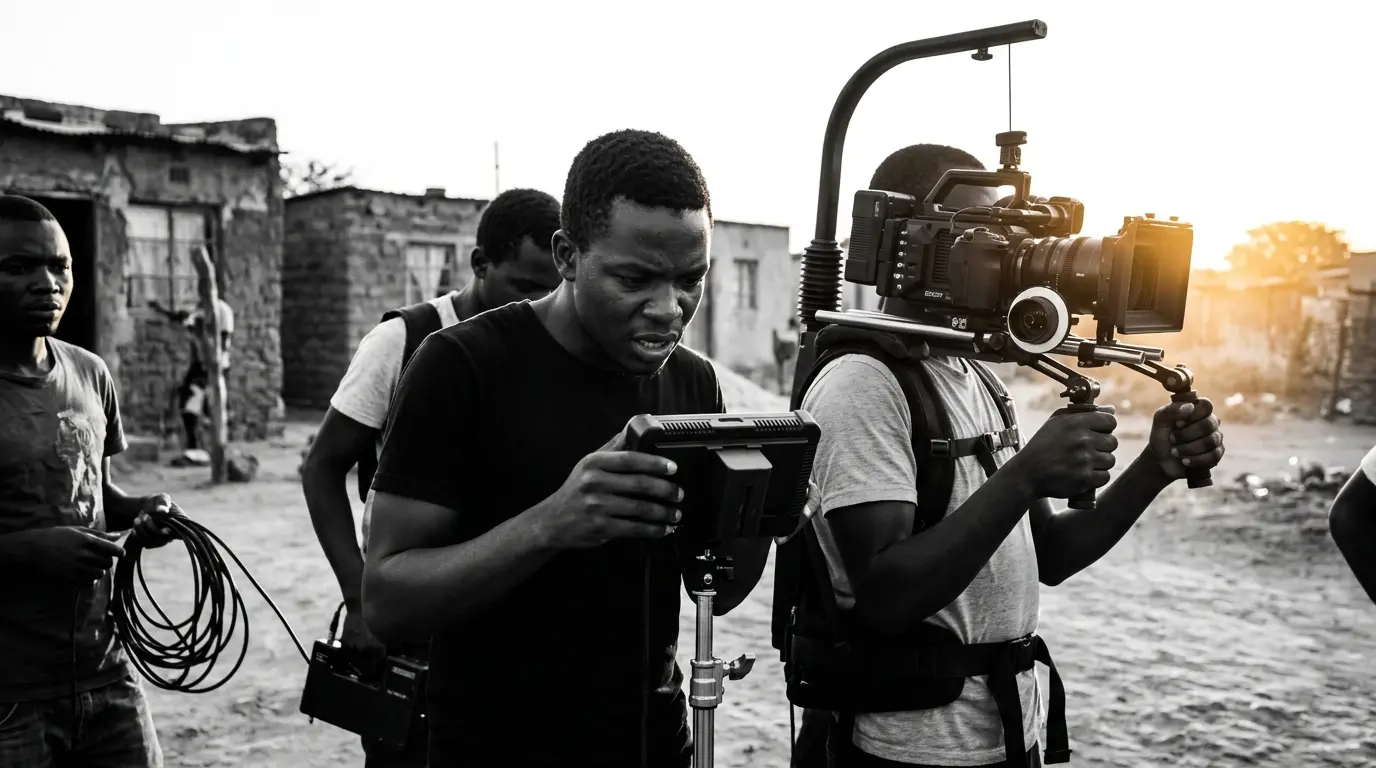
Right now, the average Zambian movie production runs on what I like to call the One-Man Army Model.
A passionate local filmmaker decides they have a story to tell. So, what do they do?
They write the script.
They hunt down and hire a tiny crew.
They scout the locations.
They act as the casting director.
They direct the shoot.
They edit the footage, do the color grading, and fix the audio.
They handle catering, logistics, and figure out where on earth to buy or rent props!
By the time the movie wraps, the poor filmmaker doesn't look like a victorious artist—they look like a survivor of a mild shipwreck.
[ Traditional Hollywood Pipeline ]
Scriptwriter ──► Producer ──► Director ──► Casting ──► Crew ──► Editor ──► Distributor
                                      VS.
[ The Zambian "One-Man Army" Model ]
Filmmaker ──► Does EVERYTHING Above Alone ──► Starts Over From Zero Next Project
And here’s where the real pain sets in: there is zero reusable infrastructure.
When that same filmmaker finishes their movie and wants to start a second project six months later, do they have a streamlined system to rely on? Absolutely not! They have to figure out location permits all over again by word-of-mouth. If the script requires a police officer or a squad car, they have to navigate bureaucratic red tape through personal favors. If they need original music, they have to hunt down composers individually.
When a brand-new filmmaker steps up to make their first movie, they can't leverage a shared industry network. They have to reinvent the wheel from scratch!
Even when it comes to distribution, a few resourceful producers manage to build personal contacts and get their films into decent African or international film festivals. But because there’s no centralized distribution clearinghouse or shared industry knowledge base, the next filmmaker behind them has to go out and forge those exact same contacts all over again.
We are operating in silos. And operating in isolation is costing us precious time, energy, and money.
Breaking Free from "Government Dependency"
Let’s step back and look at the bigger economic picture for a moment.
It is a well-documented economic reality that the healthiest, most resilient countries on Earth are those with highly diversified economies. They don't rely on a single mineral or a single employment sector to keep millions of citizens fed.
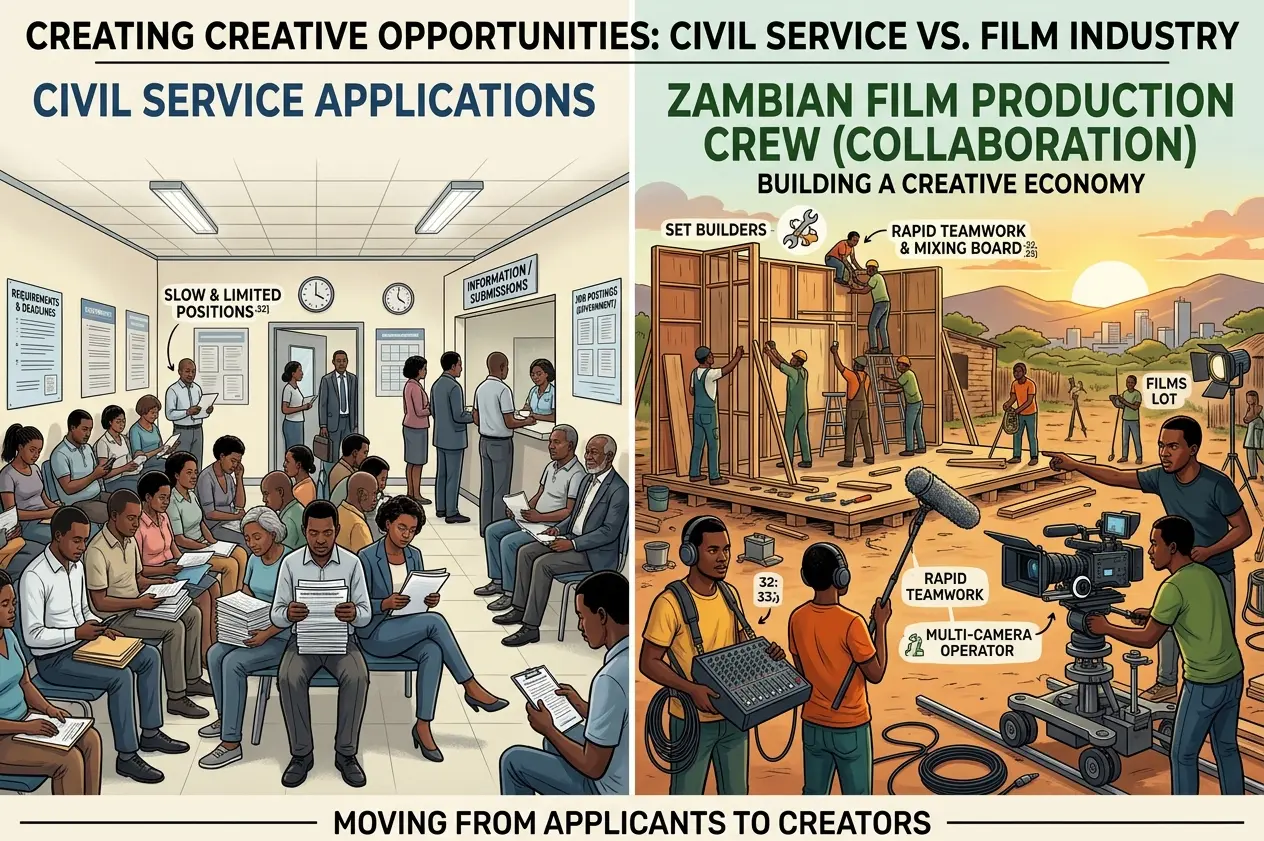
In Zambia, we have developed a cultural mindset that I call Government Dependency.
During election cycles, politicians stand on podiums and sincerely promise, "We will create 500,000 jobs for the youth!" And while those intentions might be noble, the mathematical reality is brutal: THE GOVERNMENT CANNOT EMPLOY EVERYONE.
The Job Illusion:   [ University Degree ] ──► [ Waiting for Civil Service Job ] ──► Stagnation
The Creative Asset: [ Creative Talent ]  ──► [ Structured Film Industry ]   ──► Sustainable Wealth
The civil service cannot absorb every university graduate, every school leaver, and every talented youth in Lusaka, Ndola, Livingstone, and the Copperbelt. We must build alternative career pathways!
Yet, how is a career in film or acting viewed in our society?
Too often, if a young person announces at the family dinner table, "I want to be an actor," or "I want to be a cinematographer," the room goes dead silent. People treat creative careers as a desperate last resort—something you settle for only if you failed your Grade 12 exams or couldn't land a comfortable office job in a government ministry.
This perspective is absurdly outdated.
People have no idea how much engineering skill it takes to design and build intricate, professional movie sets! A thriving film industry needs brilliant structural engineers who love visual storytelling. It needs acoustic engineers, digital animators, storyboard artists, costume designers, sound mixers, makeup artists, lighting technicians, and stunt coordinators.
The film industry isn't just about glamour and red-carpet premieres; it is an industrial job-creation engine with the power to employ thousands of young people and inject massive revenue into the national economy!
Lessons from the Zambian Music Industry: The Slapdee & Macky 2 Factor
If you want proof that a Zambian creative sector can transform from a localized hobby into a commercial power, look no further than our music industry.
Two decades ago, radio stations in Zambia were dominated almost entirely by foreign tracks from the US, the UK, the DRC, or South Africa. Local artists struggled for airplay, respect, and financial compensation.
What changed the game?
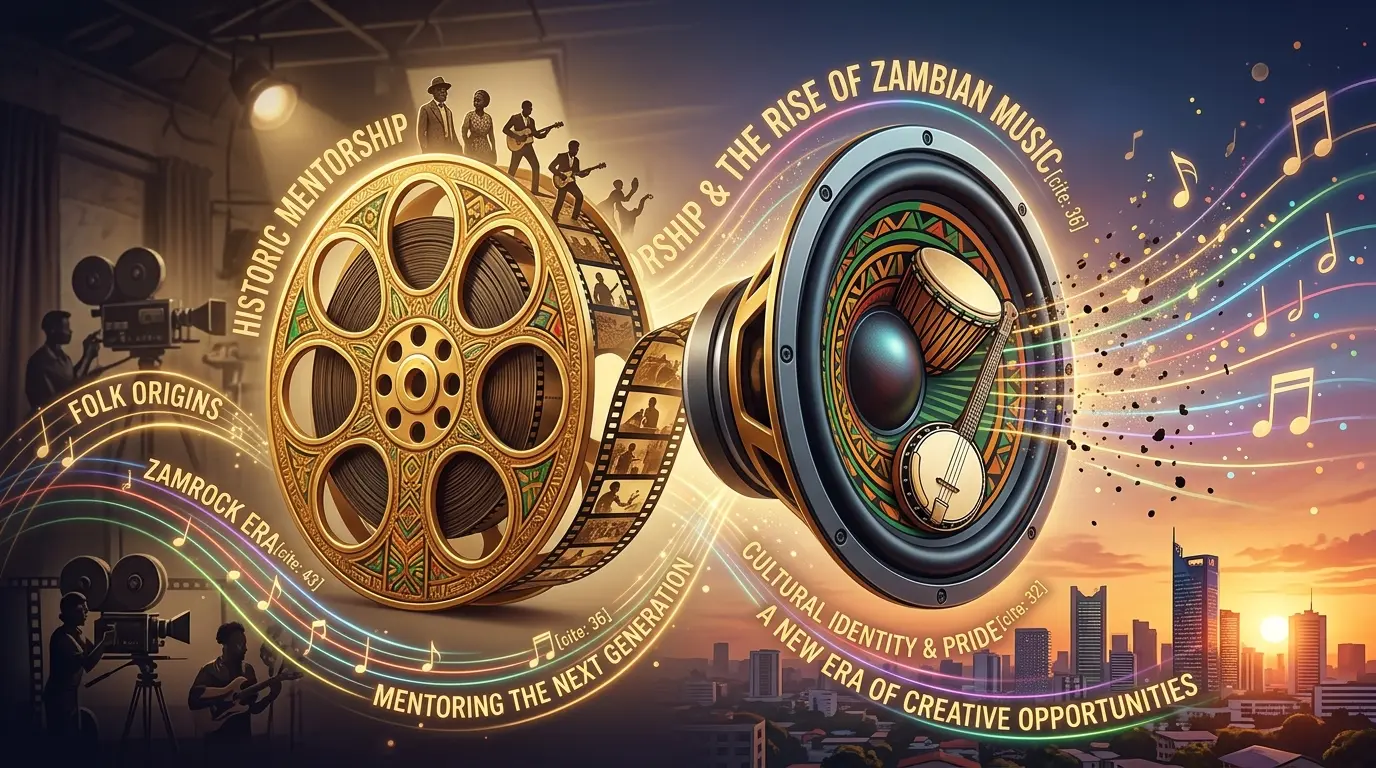
Among several pioneers, two foundational figures stand out whose legacy and influence will never be erased: Macky 2 and Slapdee.
[ The Music Blueprint ]
Mentorship + Rivalry ──► Shared Hype & Visibility ──► Ecosystem Growth ──► Commercial Industry
During their prime, Macky 2 and Slapdee didn't just drop hit records—they built movements. Through their respective labels (XYZ Entertainments and Kopala Swag), they created platforms, mentored younger talent, built recognizable brands, and constructed a structured ecosystem where artists could actually earn a living. Their legendary, friendly rivalry energized the entire country, forced radio stations to pay attention, and proved that Zambian music could fill stadiums!
The local film industry needs to take a page straight out of the music industry's playbook:
We need mentorship programs.
We need collaborative production hubs.
We need established creators bringing up the next generation rather than guarding their contacts like state secrets.
To the local filmmakers grinding in the trenches today: hang in there!
Building an industry takes time. But instead of working in complete isolation, we must start pooling resources and creating reusable structures. A few inspiring local filmmakers are already offering hands-on internships to young enthusiasts—and that is precisely how the foundation gets built.
The Ultimate Zambian Advantage: World-Class Stories at a Fraction of the Cost
Here is the secret weapon that Zambian filmmakers hold, which very few people talk about: The Cost-of-Living Arbitrage.
Hollywood has endless resources, top-tier equipment, and decades of institutional knowledge. But Hollywood also has mind-bogglingly astronomical overhead costs.
To shoot a basic, mid-budget indie drama in Los Angeles or New York, you need millions of dollars just to cover municipal permits, union fees, location rentals, and daily catering.
In Zambia, the cost of living is significantly lower.
[ Hollywood Indie Drama ]  ──► Astronomical Overhead ──► Budget: $2,000,000+
[ Zambian Feature Film ]   ──► High Creative Output ──► Budget: $50,000 (Same Narrative Impact!)
A passionate Zambian team can produce a feature film with the exact same emotional depth, narrative power, and story quality for a quarter—or even a tenth—of the budget required in Western markets!
If we establish standardized production pipelines, invest in decent cinema-grade camera gear, and streamline location permitting, Zambia can quickly become an incredibly attractive hub for regional and international film co-productions.
The Path Forward
The potential sitting inside Zambia’s creative youth is limitless. We have the culture, we have the dramatic landscapes, we have the historical lore, and we have a generation of digital-native youth eager to create.
It’s time to stop waiting for government hand-outs, stop treating film as a last-resort hobby, and start building the reusable structures, guilds, and mentorship networks that will carry this industry forward.
The credits haven't rolled on Zambian cinema—in fact, the opening scene is just beginning!