Let’s perform a quick mental experiment.
Imagine a movie where two attractive people meet at a coffee shop. They get along great. They order lattes, sit on a park bench, laugh at each other’s jokes, go out for dinner, hold hands, kiss goodnight, and spend the next two hours enjoying each other’s company with zero issues whatsoever.
How long would you stay in the theater before demanding your money back? About ten minutes, right? You’d probably end up scrolling through your phone, wondering if you accidentally bought a ticket to a pharmaceutical commercial for allergy medication.
Why? Because two people falling in love and having a lovely time isn't a story. It’s an Instagram story, maybe, but it certainly isn't a film.
This brings us to a controversial opinion that tends to upset traditional movie marketers: Romance is not a standalone movie genre. It is an engine for character arcs.
Without the framing of drama, comedy, action, sci-fi, or even horror, "pure romance" lacks the one element every single story requires to survive: conflict.
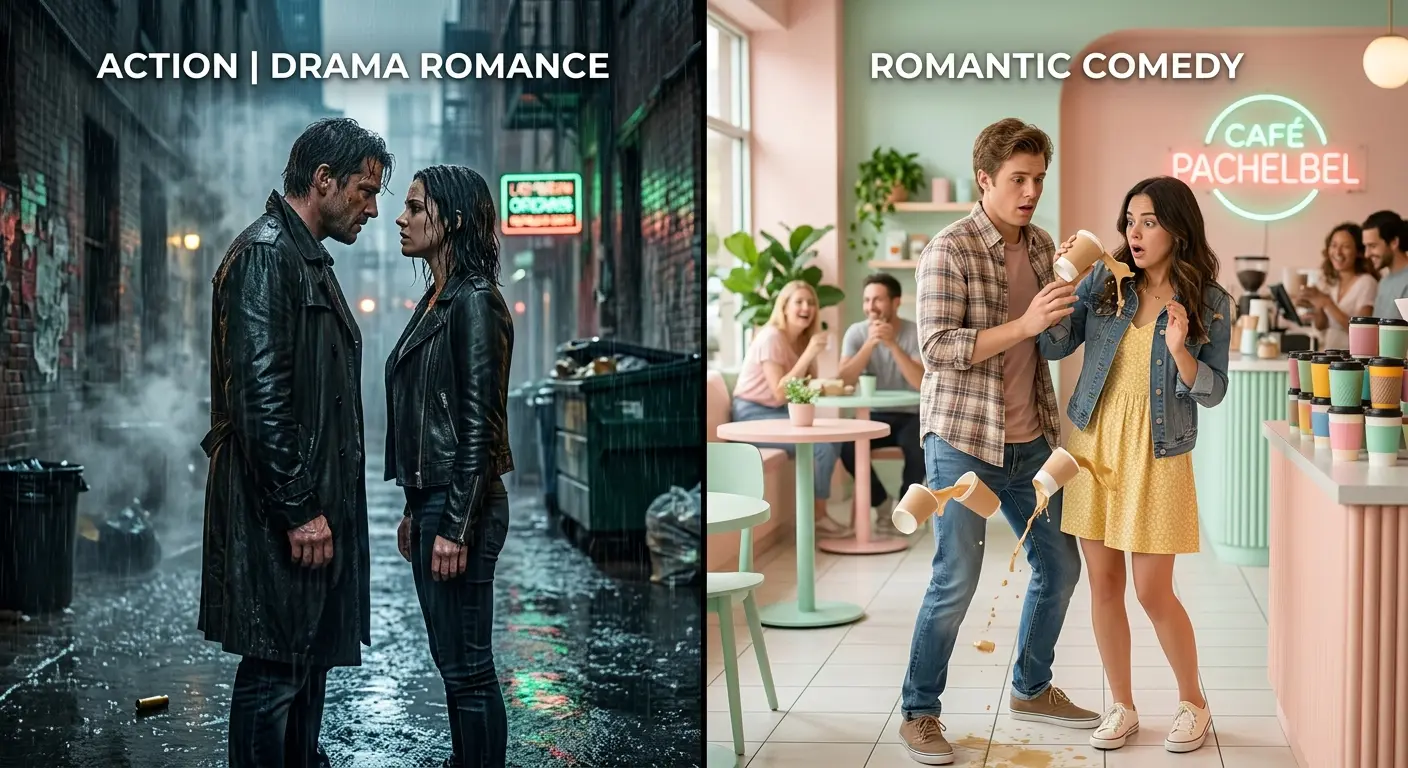
The Great "Pure Romance" Trap: All Fluff, No Stakes
Every once in a while, Hollywood serves up a film marketed as "pure romance." You know the type: light, airy, aesthetically pleasing, and utterly devoid of anything resembling real human stakes.
In these movies, two people bump into each other, realize they are both charming, and then spend 90 minutes navigating minor misunderstandings that could easily be resolved with a single five-second text message: "Hey, that was actually my cousin at the restaurant."
When a story relies solely on "romance" without genre context, nothing actually happens. There is no genuine threat to the characters' worldviews, no internal flaws to overcome, and no external pressure forcing them to evolve.
In real life, falling in love is wonderful. In cinema, watching two people fall in love without an obstacle standing in their way is about as exciting as watching paint dry—even if it's painted in soft pastel tones with a pop acoustic soundtrack playing in the background.
To make romance work on screen, you need context. And that context comes directly from established genres.
1. Romantic Comedy: Using Wit to Shield the Heart
Consider the classic Romantic Comedy. Why do rom-coms work so well when executed properly?
It isn't because of the "romance" half of the equation; it’s because of the comedy and the underlying emotional guardrails.
In a great rom-com, two characters trade witty banter, poke fun at each other, and exchange sarcastic quips. We laugh at the jokes, but as the audience, we see right through their defenses. We recognize that all that playful teasing is just a giant emotional shield. They are attracted to each other, but they are terrified of being vulnerable or getting hurt.
[ Funny Banter & Sarcasm ] ──► ( Shields Vulnerability ) ──► [ Hidden Chemistry ]
                                                                      │
                                                                 ( Growth )
                                                                      ▼
                                                          [ Admission of Feelings ]
The comedy provides the entertainment, but the character arc—watching two guarded people drop their comedic armor, confront their fears, and admit their feelings—provides the emotional payoff.
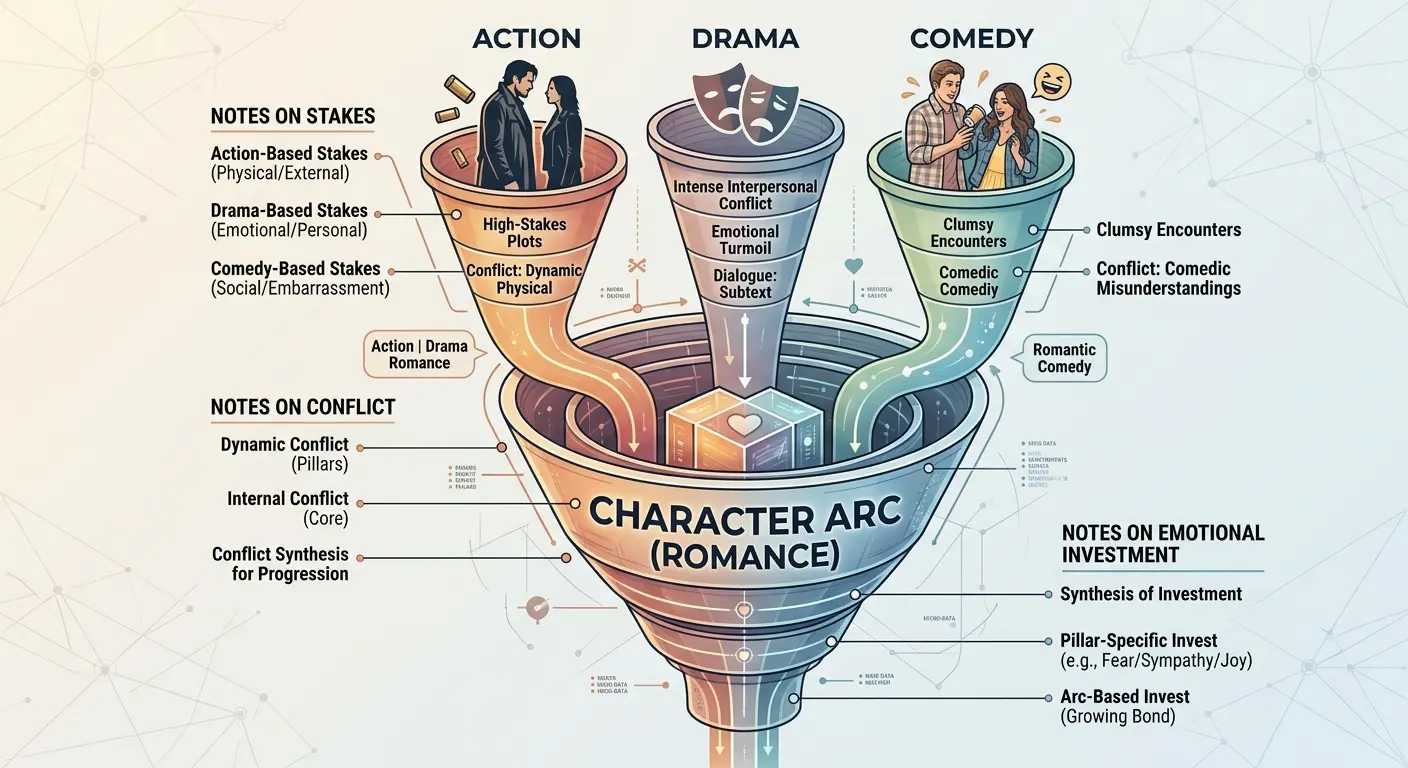
2. Action Movies: Why a Lone Wolf Needs Someone to Protect
Now, let's swing to the opposite end of the spectrum: Action cinema.
How many action movies have you watched where an ex-military operator, ex-marine, or rogue cop walks through twelve scenes completely alone, scowling at walls, and shooting nameless henchmen for two hours straight?
A guy who is totally isolated, has nothing to lose, isn't attracted to anyone, and has zero human connections isn't a complex character—he's a walking cheat code. And when a protagonist has nothing to lose, the audience has nothing to invest in.
Now, inject a romantic character arc into that exact same scenario:
Take that same ex-special forces operative on a high-stakes undercover assignment. Suddenly, he meets someone from the opposing faction or an innocent witness caught in the crossfire. He falls in love.
All of a sudden, his entire world flips on its head:
He no longer knows where to pledge his allegiance.
His icy, isolated worldview is shattered by genuine affection.
The stakes rocket through the roof because he finally has something precious to protect.
[ Cold, Isolated Action Hero ] ──► ( Meets Love Interest ) ──► [ Conflicted Loyalty ]
                                                                      │
                                                                  ( Risk )
                                                                      ▼
                                                          [ Genuine Emotional Stakes ]
Even if you take the classic revenge trope—a hero hunting down the syndicate responsible for the loss of a loved one—it only resonates if the story took the time earlier to show us that love in action.
Love provides the motivation; action provides the arena.
3. Drama, Sci-Fi, and Horror: The Ultimate Testing Grounds
The same pattern holds true across every major genre:
Drama: Provides heavy societal, financial, or personal obstacles (class differences, family feuds, illness) that test whether two people can transform internally to stay together.
Sci-Fi: Uses futuristic settings or time travel mechanics to ask deep questions about human connection—would you love someone across different timelines or realities?
Horror: Forces characters into extreme life-or-death survival situations where love becomes the ultimate reason to keep fighting against impossible odds.

Real Life vs. The Silver Screen
In real life, people fall in love every single day. We get nervous before asking someone out, worry about text response times, and rely on the bonds of family and romantic partnership to get through tough times. Love is the bedrock of human experience.
That’s precisely why romance belongs inside character arcs, not in a isolated genre silo.
When screenwriters treat "romance" as a standalone genre, they strip away the rich context that gives human relationships their meaning. But when they treat romance as an internal transformation—a journey where a character starts off guarded, selfish, or isolated, and grows into someone capable of deep connection through external trials—they create unforgettable cinema.
The next time you watch a great movie that leaves you reaching for tissues or cheering in your seat, take a closer look under the hood.
You aren't just watching two people fall in love. You are watching a fantastic drama, action, or comedy story where love happened to be the force that changed the characters forever!