If you are reading this article in Lusaka, Ndola, Livingstone, or anywhere else in Zambia, you are currently experiencing a genuine technological miracle.
Right now, billions of microscopic pulses of laser light—carrying millions of TikTok videos, WhatsApp voice notes, and frantic last-minute Google searches—are traveling thousands of kilometers across dark, crushing ocean trenches, snaking along high-voltage electricity pylons, leaping between metal towers, and landing directly onto your smartphone screen.
All of this happens in a fraction of a second.
Yet, most of us only ever think about the internet when the little Wi-Fi icon gets a tiny exclamation mark next to it and our favorite video freezes on a blurry frame.
How does the internet actually get all the way here? How does a landlinked nation in the heart of Southern Africa get high-speed access to data servers hosted in London, Virginia, or Singapore?
Grab a drink. We are going to break down the incredible journey of a single byte of data—from undersea glass cables to neighborhood towers—and look at the satellite alternative disrupting the entire game.
Act I: The Magic of Fiber Optics (Firing Lasers Through Glass)
To understand internet infrastructure, you first have to appreciate fiber optics.
Forget everything you know about old copper telephone wires that used electrical currents to send data. Fiber optic cables are made of ultra-pure, razor-thin strands of glass—literally the width of a human hair.
Instead of electricity, fiber optics use light.
A specialized laser transmitter at one end flashes light pulses billions of times per second down the center of the glass strand. Thanks to a physics phenomenon called total internal reflection, the light bounces along the inside of the glass tube without escaping, traveling at roughly 200,000 kilometers per second.
Laser Light Pulse ──► [ Outer Protective Jacket ]
                        [ Cladding Material ]
                          [ Ultra-Thin Glass Core ] ──► Photodiode Receiver
To protect these delicate glass threads from underwater hazards like anchor drops, geological shifts, and curiosity-driven shark bites (yes, deep-sea sharks actually used to bite ocean cables early on!), engineers wrap the glass inside heavy layers of steel wire, copper tubing, waterproof gel, and thick plastic casing.
The result? A cable about the thickness of a garden hose that can transmit terabytes of data across entire oceans every single second.
Act II: The Subsea Highway to Africa
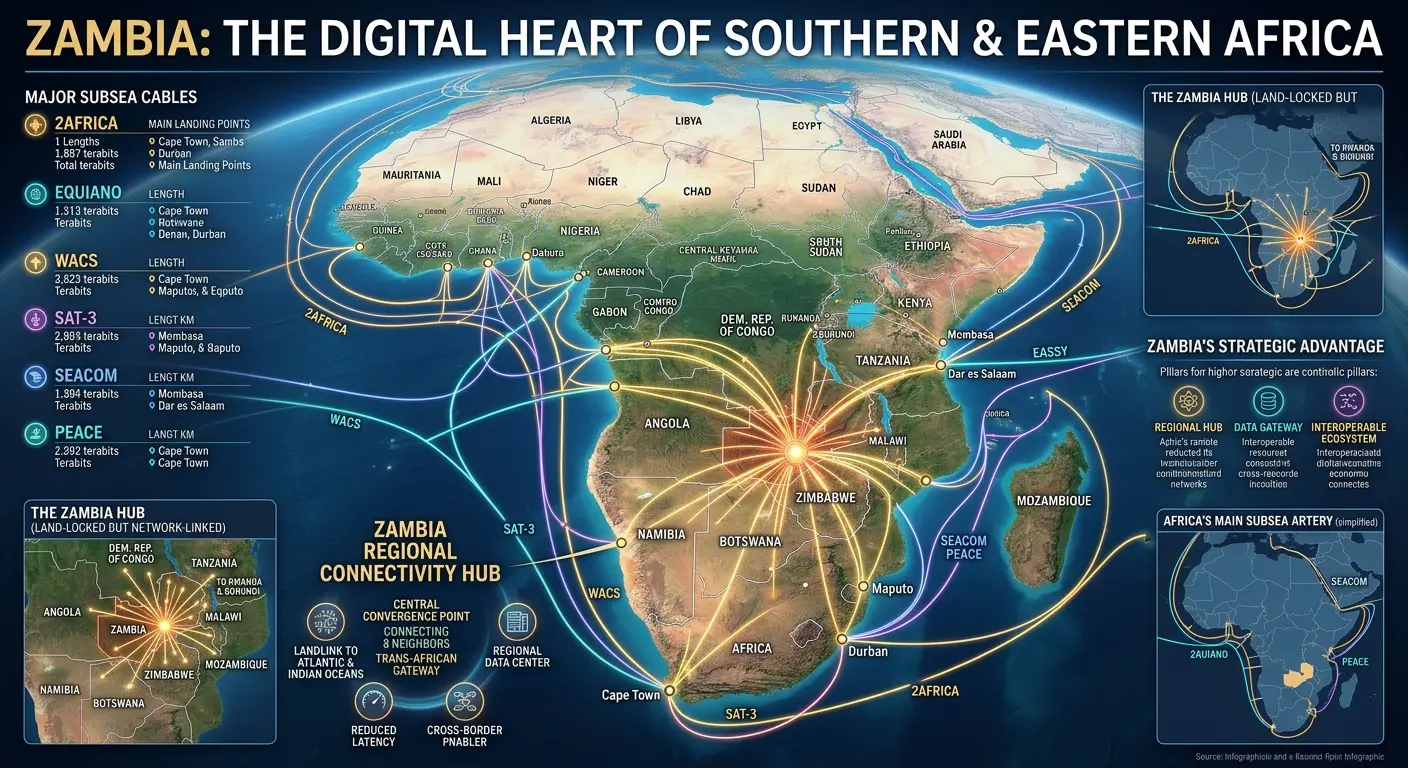
Because Zambia is landlinked, we don't have an ocean coastline where a giant cable ship can simply park and plug a wire into the beach. We rely on colossal subsea cable systems that encircle the African continent.
These massive underwater highways lie thousands of meters deep on the ocean floor, connecting Africa to Europe, the Middle East, Asia, and the Americas:
EASSy (Eastern Africa Submarine Cable System): Runs along the east coast of Africa from South Africa all the way up to Sudan.
SEACOM: Another massive east-coast optical highway linking South Africa, Mozambique, Tanzania, and Kenya directly to Europe and Asia.
WACS (West Africa Cable System): Sweeps down the west coast from the United Kingdom, landing at points in West Africa and ending in South Africa.
2Africa: One of the most ambitious subsea projects in human history, wrapping entirely around the African continent to dramatically expand data capacity.
When you hit "Send" on a message, that request shoots off to coastal landing stations in countries like Mozambique (Maputo/Beira), Tanzania (Dar es Salaam), Namibia (Walvis Bay), or South Africa (Mtunzini/Cape Town).
Great! The data made it to the edge of the continent. But how does it cross thousands of kilometers of dry land to reach us?
Act III: Crossing Borders and Ridin' the Power Lines
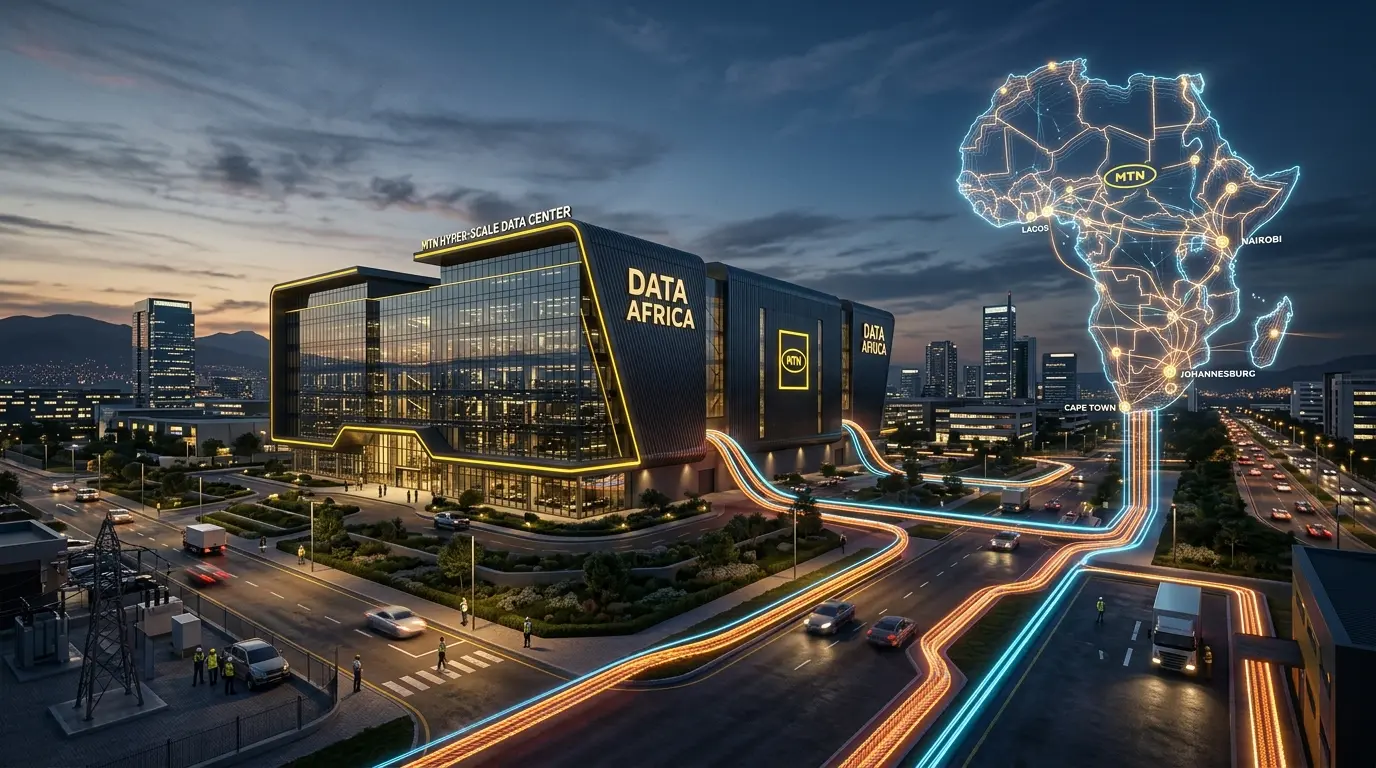
This is where terrestrial fiber optic networks step onto the stage. Specialized telecommunications providers—such as Liquid Intelligent Technologies, ZAMTEL, Airtel, MTN, and power utility networks like ZESCO and Copperbelt Energy Corporation (CEC)—have laid tens of thousands of kilometers of terrestrial fiber.
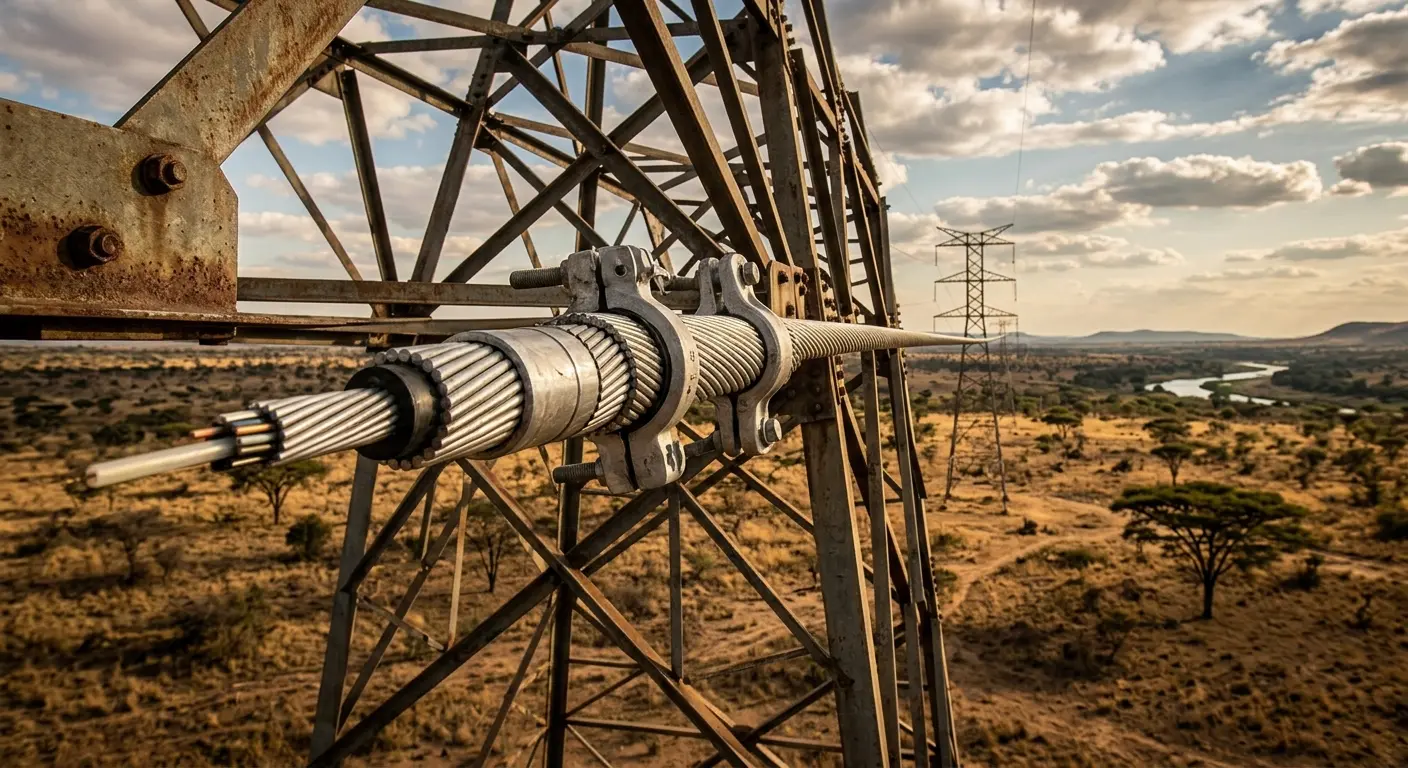
Instead of digging up thousands of kilometers of dirt roads (which is expensive, slow, and prone to accidental cuts during roadwork), power utilities realized something brilliant: they already had massive electricity grids stretching across the entire country!
They installed OPGW (Optical Ground Wire) cables on high-voltage electrical pylons.
An OPGW cable serves a double purpose: the outer aluminum shell acts as a lightning rod to protect the electrical grid, while the hollow center contains dozens of fiber optic glass strands.
Data enters Zambia through several key border gateways:
From the South (via Zimbabwe/Botswana): Crossing the Victoria Falls or Kazungula bridges.
From the East (via Mozambique/Malawi): Coming through eastern terrestrial links.
From the North (via Tanzania): Crossing at the Nakonde border post.
Once inside Zambia, the data zips along national backbone lines straight into primary data centers and routing hubs in Lusaka and the Copperbelt.
Act IV: The Last Mile—4G vs. 5G Towers
Now the data is in your city. But unless you have a direct FTTH (Fiber to the Home) cable plugged straight into your home router, you need a wireless connection for your smartphone.
This final leap is called The Last Mile, and it relies on mobile cell towers.
[ Data Center ] ──(Fiber Cable)──► [ Cell Tower Base Station ] ──(Radio Waves)──► [ Your Phone ]When data reaches a local cell tower via underground fiber, the tower converts those light pulses into radio frequency waves broadcast through the air. Your phone’s internal antenna picks up those waves and translates them back into text, images, and video.
The Evolution: 4G LTE vs. 5G
You've probably noticed your phone switching between 4G and 5G indicators. Here is how they actually differ:
Feature | 4G LTE | 5G Network |
|---|---|---|
Frequency Range | Lower frequencies (below 3 GHz) | Higher frequencies (including mid-band and millimeter wave) |
Coverage Area | Broad coverage (one tower covers several kilometers) | Smaller cell coverage (requires more dense mini-towers) |
Latency (Lag) | ~30 to 50 milliseconds | Down to 1 to 5 milliseconds |
Top Speeds | Up to ~100 Mbps in practice | Can exceed 1,000 Mbps (1 Gbps) |
While 4G is fantastic for streaming HD movies and general browsing over long distances, 5G uses higher-frequency radio waves to transmit staggering amounts of data with almost zero lag.
Because high-frequency 5G signals don't travel as far and can be blocked by thick walls or trees, networks have to install smaller, denser clusters of 5G micro-transceivers around urban areas.
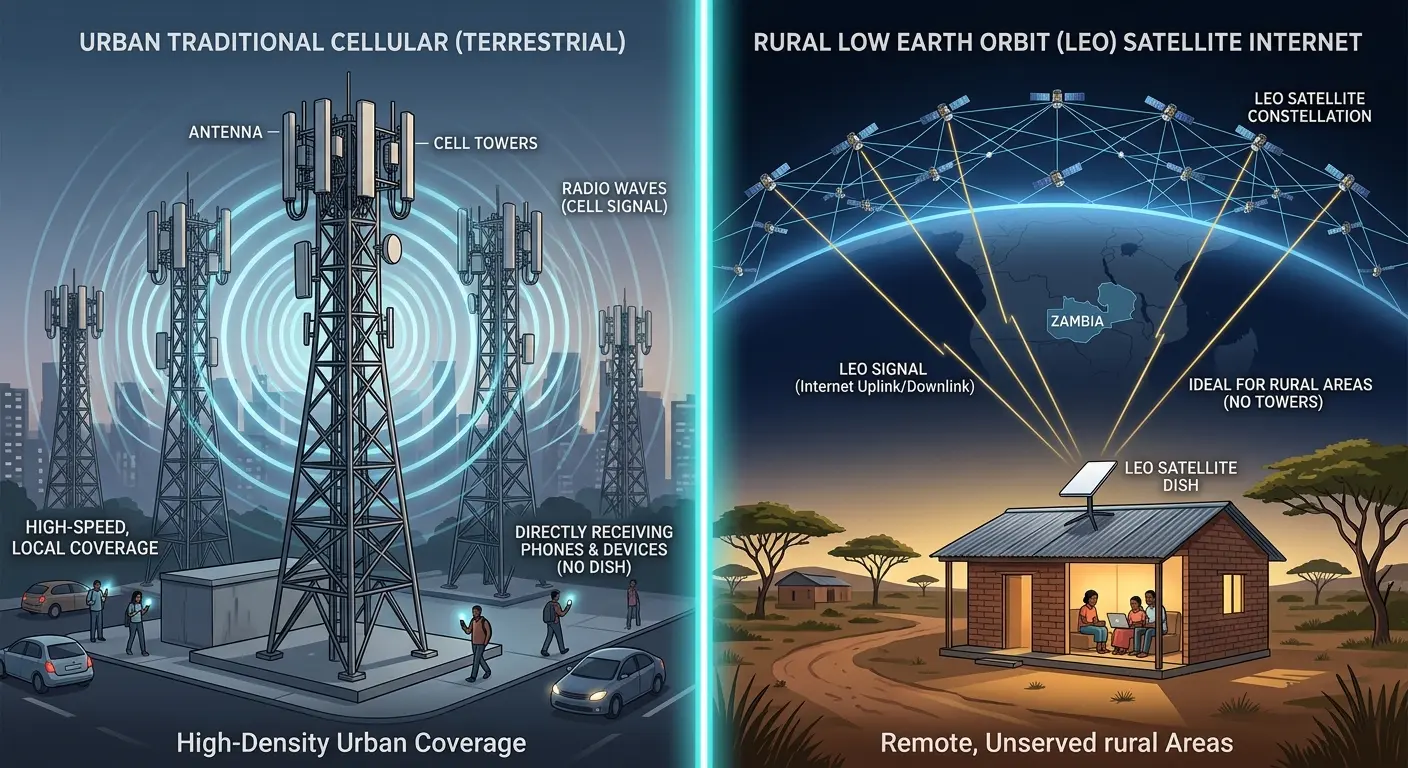
The Alternative: Starlink and Low Earth Orbit Satellites
What happens if you are off the grid—in a remote lodge in Kafue National Park, a farm out in Mkushi, or a rural village far away from fiber backbones and 4G towers?
Digging trenches for fiber or erecting $100,000 cell towers for a sparse population doesn't always make financial sense for traditional telecom companies. This is where Starlink transformed the entire equation.
Traditional satellite internet relied on massive geostationary satellites parked roughly 35,786 kilometers above the Earth. Because the distance was so immense, the signal took forever to travel up to space and back down—resulting in terrible lag (high latency) that made video calls and gaming almost impossible.
Starlink changed the game by launching a "constellation" of thousands of tiny, mass-produced satellites into Low Earth Orbit (LEO), just 550 kilometers above Earth's surface.
[ Subsea Ocean Cable ] ──► [ Starlink Ground Station / Gateway ]
                                       │
                                (Laser Uplink)
                                       ▼
                       [ Low Earth Orbit Satellite ] (550 km)
                                       │
                               (Direct Downlink)
                                       ▼
                         [ Your Starlink Roof Dish ]
How Starlink Reaches Your Living Room:
High-speed fiber optics bring global data to a regional Starlink Ground Station (Gateway) on Earth.
The gateway beams that data straight up to an overhead satellite using high-frequency radio signals.
Satellites can pass data to each other in space using space-based optical lasers.
The satellite beams the signal directly down to the small motorized dish mounted on your roof, which plugs straight into your indoor Wi-Fi router.
Because the satellites are so close to Earth, latency drops from a painful 600ms down to a crisp 25–50ms—giving remote farms and rural schools the exact same high-speed access enjoyed by corporate offices in capital cities.
The Grand Tour: A Byte's Journey in Milliseconds
To put this incredible infrastructure into perspective, let's trace what happens when you tap a button to load an image hosted on a server in Europe:
0 ms: Your phone sends a radio request through the air to your nearest local 4G/5G cell tower.
5 ms: The tower converts the radio wave into light and shoots it down an underground fiber optic cable.
15 ms: The signal zooms along ZESCO/CEC overhead power lines, crossing national borders into neighboring countries.
40 ms: The light enters an undersea ocean cable system (like EASSy or WACS) and zips along the seabed at light speed.
80 ms: The signal arrives at a European data center, grabs the image file, and turns around.
160 ms: The entire journey repeats in reverse, delivering the photo straight to your screen before you can even finish blinking.
Respect the Light!
The next time you stream a song, join a video call, or send a text message across the country, take a quick moment to appreciate the sheer mechanical genius keeping us connected.
Whether it's light bouncing inside hair-thin glass strands laid across the ocean floor, signal streams traveling along high-voltage electricity grids, or satellite constellations orbiting hundreds of kilometers above our heads, the global internet is easily one of humanity's greatest achievements.
So the next time your video buffers for two seconds... take a deep breath, smile, and remember that a laser just traveled halfway around the planet through a glass tube under the ocean just for you!