Every screenwriting guru with a ring light, a microphone, and an online course seems to deliver the exact same gospel to beginners: “Start small! Write a short script first! It’s your Minimum Viable Product!”
On paper, this sounds like perfectly rational advice. It’s the screenwriting equivalent of dip-your-toe-in-the-water engineering. You write a neat five-page script, finish it quickly, feel a warm sense of accomplishment, and theoretically stack those small wins until you’re ready to tackle a 110-page behemoth feature.
Theoretically, it’s brilliant. Practically? It’s a trap.
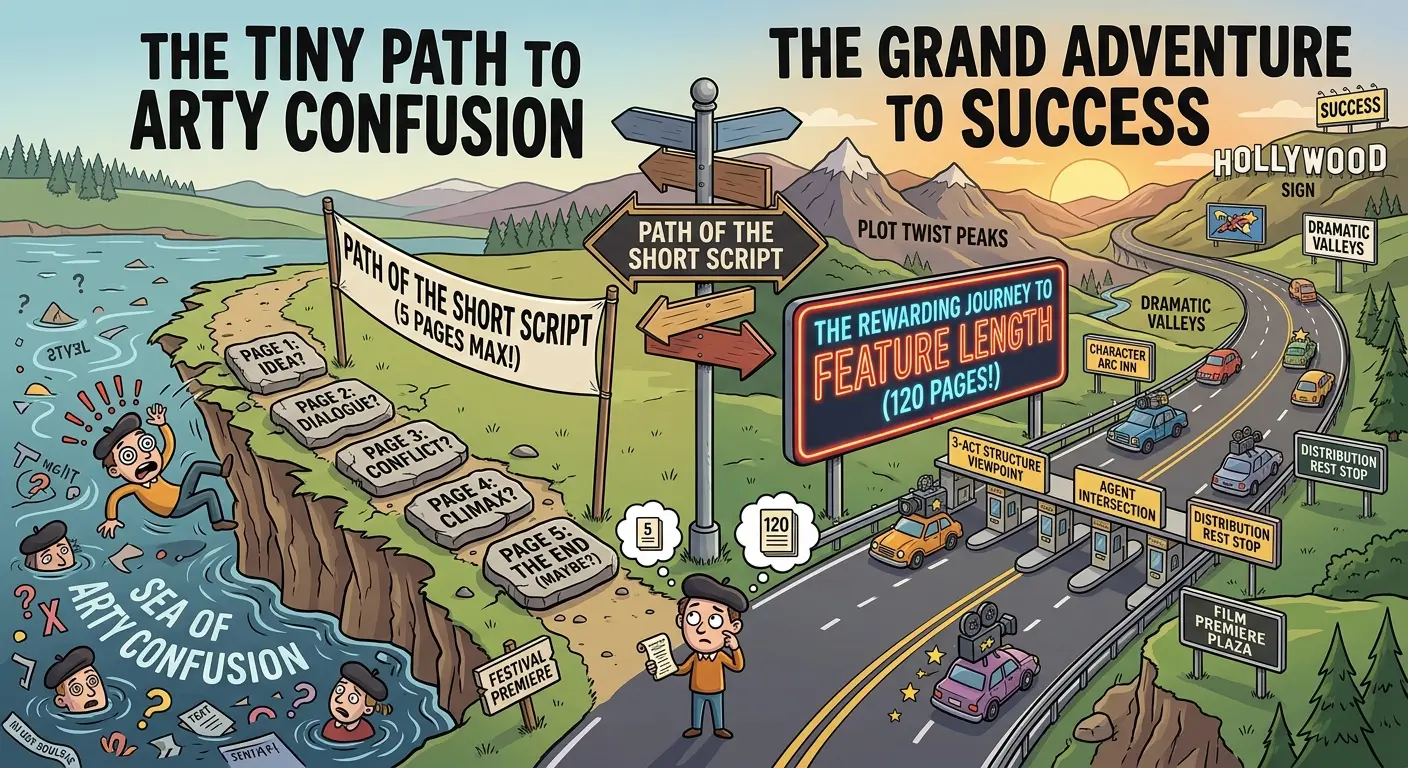
Here is the inconvenient truth that most gurus won’t tell you: writing a genuinely good short film requires significantly more advanced storytelling skill than writing a complete feature-length screenplay. If you’re a beginner trying to learn the craft, diving straight into feature scripts isn't just better—it’s the fastest, most effective way to actually learn how story structure works.
Let’s dismantle the “shorts first” myth and look at why going big right out of the gate is the ultimate masterclass for pure screenwriters.
The Illusion of the “Easy” Short Film
Why do gurus champion short films? Because completing a project feels good, and shorts are quick to finish. But finishing something quickly doesn't mean you've learned how to tell a story.
In a short film, time is actively working against you. You have roughly five to fifteen minutes (and pages) to establish a protagonist, set up world rules, build rising action toward a climax, and deliver an emotionally satisfying resolution. To pull that off, a writer must explore dozens of ideas and ruthlessly discard 90% of them to focus only on the absolute core essence of the scene.
That kind of hyper-disciplined economy of storytelling isn't a beginner skill; it's an advanced art form built on years of experience.
When beginners try to write short scripts before understanding full dramatic structure, the results are almost universally the same: shallow, eventless vignettes where nothing really happens. We’ve all seen these shorts at indie festivals. A character stares pensively out a rain-slicked window for four minutes, sighs, drinks cold coffee, and the screen fades to black. When you ask the writer what the conflict was, they lean back, put on their best pretentious auteur face, and whisper: “It’s about psychological conflict.”
No, it isn't. It’s about five pages of missing plot! 😄
More often than not, an idea ends up as a short film simply because it was never strong or dynamic enough to sustain a full feature in the first place. You aren't learning how to build an engine; you're just polishing a single hubcap.
Why Features Are the Ultimate Screenwriting Sandpit
Writing a 90-to-120-page feature screenplay is intimidating, no question about it. But that exact scale is what makes it such a powerful learning tool.
A feature script gives you room to breathe. It allows you—and frankly, demands of you—to throw all your junk onto the page without time constraints. In a first draft feature, you have the space to explore subplots, test character dynamics, write long conversations, and experiment with set pieces.
You can’t find gold if you don't dig up a little mud first. The feature length forces you to unleash your imagination and dig deep into your personal experiences and knowledge of dramatic storytelling to keep the engine running for 100 pages.
The true magic of screenwriting doesn't happen during the first draft anyway; it happens during the rewrite.
When you write a full feature, you end up with a complete narrative ecosystem. You can take that sprawling draft to mentors, peer writers, or script consultants and get real feedback. During the polish and rewrite phases, you learn:
Which subplots actually drive the central narrative and which ones drag it down.
How character arcs evolve over a long journey rather than a single moment.
How to separate genuinely brilliant story nuggets from shallow filler.
How to trim the fat and refine raw narrative mess into a sleek, high-stakes cinematic script.
You simply cannot learn the mechanics of pacing, midpoints, subplots, and second-act slowdowns from a 7-page script about a guy arguing with a vending machine.
The "Director in Disguise" Trap
So why does the "write a short first" advice remain so stubbornly pervasive?
Because the people giving that advice are usually aspiring directors or writer-directors, not pure screenwriters. And for a director, writing a short film makes complete, logical sense!
In film school, the goal is simple: write a short script, grab a camera, call your friends, and shoot it over the weekend. The entire focus is on bringing a visual concept to life on a shoestring budget. If the screenplay itself is a bit thin or derivative, it doesn't matter as much because the exercise is about camera angles, lighting, directing actors, and editing.
When you write for a low-budget short you intend to direct, your creativity is immediately caged by your practical constraints:
“I can only write two characters because that’s how many friends I have.”
“The whole story has to take place in a bedroom because my landlord won't let us shoot in the hallway.”
“No explosions or stunts because my budget is $150 and a pizza.”
While that’s fantastic training for an aspiring director learning production, it restricts a pure screenwriter’s creative muscles. As a pure screenwriter, your job isn't to worry about the rental cost of an Arri Alexa camera—your job is to create a compelling, undeniable, emotionally captivating story on paper.
When directors write short films, the story often becomes secondary to the visual execution. But for a screenwriter, story is the entire ballgame.
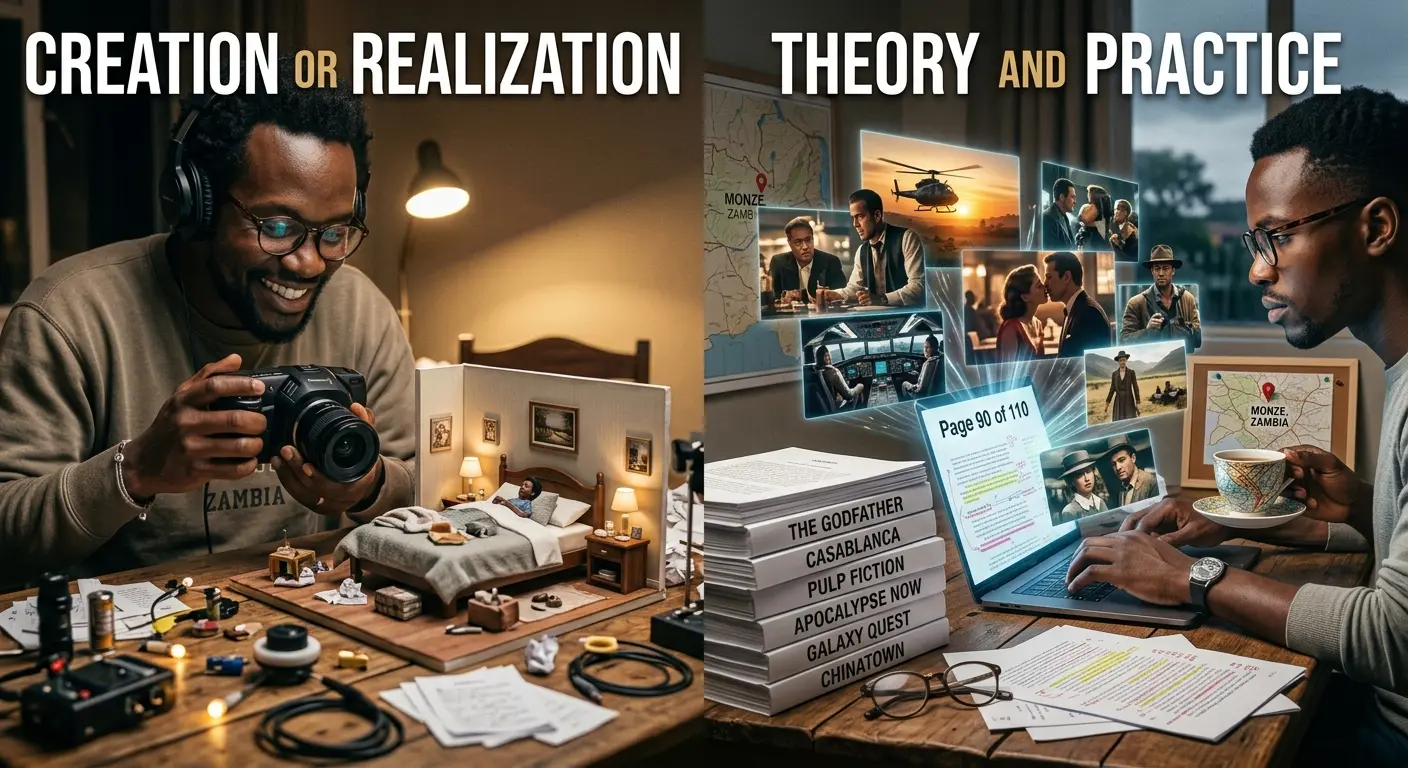
How Pure Screenwriters Actually Master the Craft
If you want to be a pure screenwriter—the person whose words command the reader's imagination from page one—your path looks very different from a film school production track.
You don't need a mini DV camera or a micro-budget short script. Here is how you actually learn the trade:
Read Great Screenplays: Read dozens of produced feature scripts in every genre. Notice how professional writers structure three-act arcs, format action blocks, handle dialogue subtext, and manage narrative momentum over 110 pages.
Study Format and Mechanics: Master screenplay formatting until it becomes second nature, so your mechanics never distract from your story.
Write the 90–120 Pages: Banish perfectionism, pick a strong high-concept idea, and push through to the end of a full-length feature script. Finishing 100+ pages builds the narrative stamina you need for a serious career.
Embrace the Feedback Loop: Get harsh, constructive notes from mentors, coverage readers, and fellow writers. Learn to cut what doesn't work and double down on what does.
Short films are fine for directors wanting to test camera gear or make a festival calling card. But if your goal is to master story architecture, character transformation, and dramatic tension, stop dipping your toes in the shallow end.
Grab your big idea, dive into the deep end, write that feature screenplay, and don't look back!