Let’s be honest with each other for a second: sitting through a traditional soap opera is, for anyone who appreciates real dramatic architecture, absolute visual torture. I say this as someone who understands storytelling to a very comfortable degree—having penned four feature film screenplays (still sitting in my drawer, but hey, Rome wasn’t built in a day, right?). The melodrama, the wide-eyed dramatic gasps, the dialogue so on-the-nose you could use it to measure a doorway—it’s enough to make a writer want to throw their laptop out a third-story window. Okay, fine, maybe there are a few good soap operas out there somewhere in the wild... but let's not push our luck. 😄
When we step away from daytime melodramas and enter the world of episodic television, storytelling splits into two distinct flavors. On one end, you have traditional procedurals—neat little forty-minute movies where a crime is committed, investigated, and solved before the end credits roll. On the other end, you have high-stakes serialization. And nestled right in the sweet spot between these two formats lies one of my absolute favorite TV tropes: the long-concealed central secret.
A long-running mystery acts as the engine of a series. It drives the narrative, creates relentless tension, and keeps us anchored to our couches season after season. But here is the catch: as a show goes on, the audience's expectations don't just stay flat—they skyrocket. That means the show eventually has to deliver big, and it has to do it at the exact right time. The big reveal needs to be worth every single year of suspense, or else the entire house of cards collapses.
Let’s dissect three iconic shows that built their entire premise on a massive, overarching secret—How I Met Your Mother, The Mentalist, and The Blacklist—and examine who nailed the payoff, who stumbled, and who is still walking the tightrope.
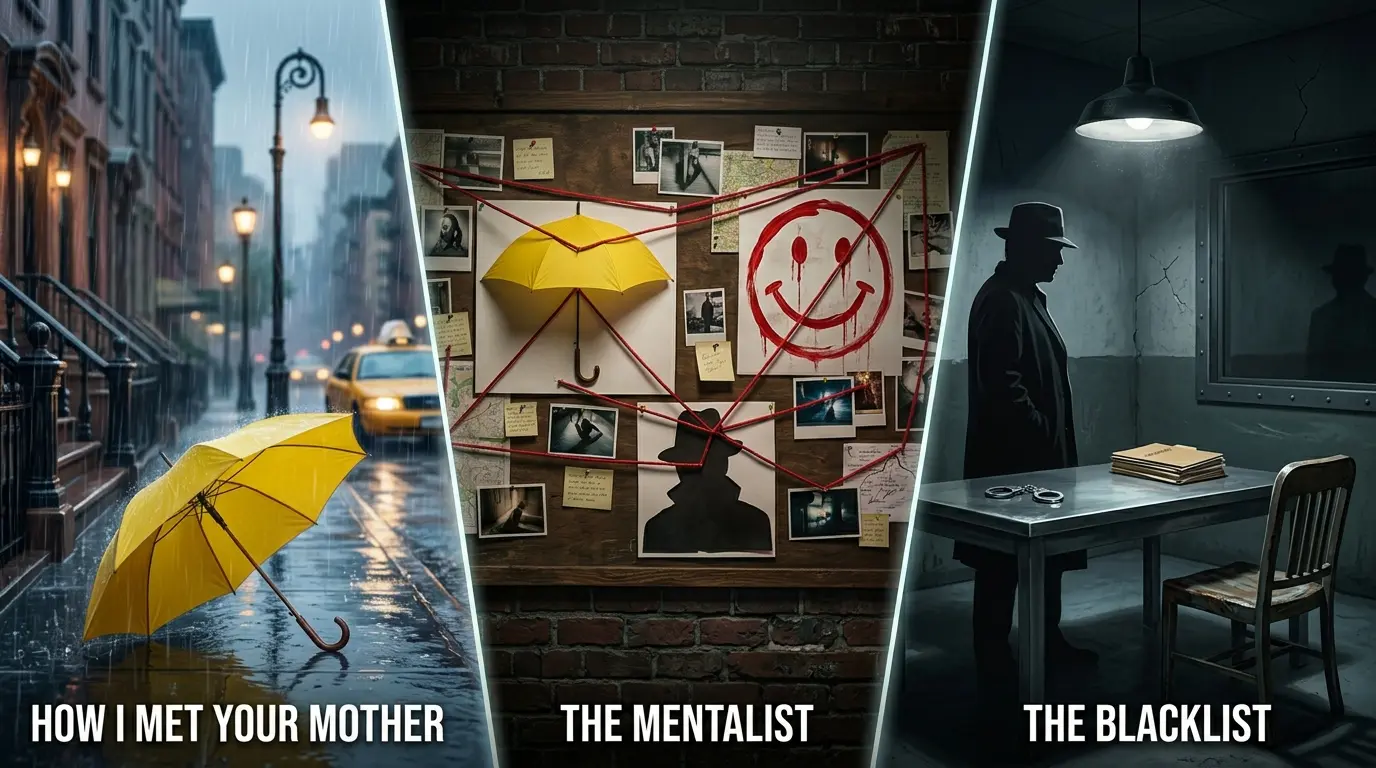
1. How I Met Your Mother: The Gold Standard of The Mystery Sitcom
How I Met Your Mother remains my absolute favorite comedy of all time, and a huge part of its genius lies in how it handled its central question.
Usually, sitcoms rely entirely on character interactions and episodic comedy to survive. But HIMYM introduced a serial narrative mystery right from its pilot episode: Who is the mother of Ted’s children?
For nine seasons, the show tantalized us with subtle clues—a yellow umbrella, a left shoe, a class on economics, a brief glimpse of a foot on a bus stop curb. As a storyteller, I deeply appreciate the sheer restraint required to pull this off. When you hold a secret up your sleeve for almost a decade, you run a serious risk of frustrating your audience. How scandalous is this secret? How high are the emotional stakes? In a comedy, the emotional weight comes from romantic investment.
And HIMYM delivered. The secret was revealed at precisely the right time, introducing Tracy McConnell in a way that felt organic, earned, and completely satisfying. They built up an impossible expectation and somehow managed to meet it with warmth and humor. That is how you execute a long-con mystery payoff.

2. The Mentalist: A High-Stakes Build-Up With a Deflating Finish
Then we have The Mentalist. Man, I loved sitting down to watch Patrick Jane outsmart serial killers and arrogant suspects. Simon Baker’s acting as the charming, grieving, hyper-observant consultant was nothing short of brilliant. The stakes were sky-high, the tragic backstory was deeply compelling, and Red John was built up as an almost mythical, omnipresent criminal mastermind.
For years, the burning question was: Who is Red John?
And then... the reveal happened. 😔
Personally, I was deeply disappointed. After seasons of agonizing anticipation, Red John turned out to be Sheriff Thomas McAllister—an obscure, elderly character whom nobody in the audience really cared about or remembered from season one. Sure, the show tried to justify it by making him the head of the "Blake Association," a secret syndicate of corrupt law enforcement officers. But the character lacked screen time, presence, and above all, he simply wasn't a formidable enough adversary to match the years of psychological warfare he inflicted on Patrick Jane.
When you ask an audience to invest years into a mystery, the antagonist needs to match the weight of the intrigue. The Mentalist proved that if your secret villain lacks presence, the entire mystery feels deflated.
3. The Blacklist: When Audience Empathy Outweighs The Lore
That brings me to The Blacklist. Now, full disclosure: I haven't finished the series yet—I’m currently powering through Season 9.
The Blacklist is a fascinating beast because its central secret is multi-layered. In Season 8, we finally got a deluge of answers regarding the "lore"—Katarina Rostova’s past, Dom, N-13, the Archive, and the true fate of the original Raymond Reddington. Were those answers worth the wait? Um... a bit.
Here is the key takeaway for any writer: it matters immensely which characters you get the audience to care about.
While the showrunners spent seasons spinning elaborate webs about international espionage and decades-old intelligence files, the audience wasn't lying awake at night thinking about N-13. We cared about the man standing in front of us—the enigmatic, charismatic Raymond Reddington played magnificently by James Spader, his deeply emotional connection to Elizabeth Keen, and why on earth he entered her life to protect her at the cost of everything else.
The lore is fine, but audience empathy is king. The real emotional secret—Reddington's true personal connection to Liz and the genuine motive behind his decades of secrecy—is the true heart of the show. As I push deeper into the later seasons, my fingers are crossed that the writers deliver a payoff worthy of Red's unforgettable character.
The Verdict: Respect Your Viewer's Patience
Writing a story driven by an elusive, long-concealed secret is a high-wire act. If you pull the trigger too early, you lose your narrative tension. If you wait too long without giving meaningful progression, your audience checks out. And if your ultimate reveal doesn't match the magnitude of the setup, you risk alienating the very people who championed your show from day one.
As viewers (especially those of us who like to analyze story structure with a fine-tooth comb), we don't just want a twist for the sake of a twist. We want a reveal that respects our patience, validates our emotional investment, and makes the long journey worthwhile.
Now, if you'll excuse me, I have to get back to Season 9 of The Blacklist to see if Red finally comes clean!