Introduction: Why Your Business Card Isn’t Doing the Heavy Lifting Anymore
Let’s be honest. For a long time in Zambia, doing business relied on three main pillars: word of mouth, an overused WhatsApp Business account, and a pocketful of glossy business cards that usually ended up lost in the bottom of someone's handbag or used as improvised toothpicks after a heavy meal of nshima and chicken.
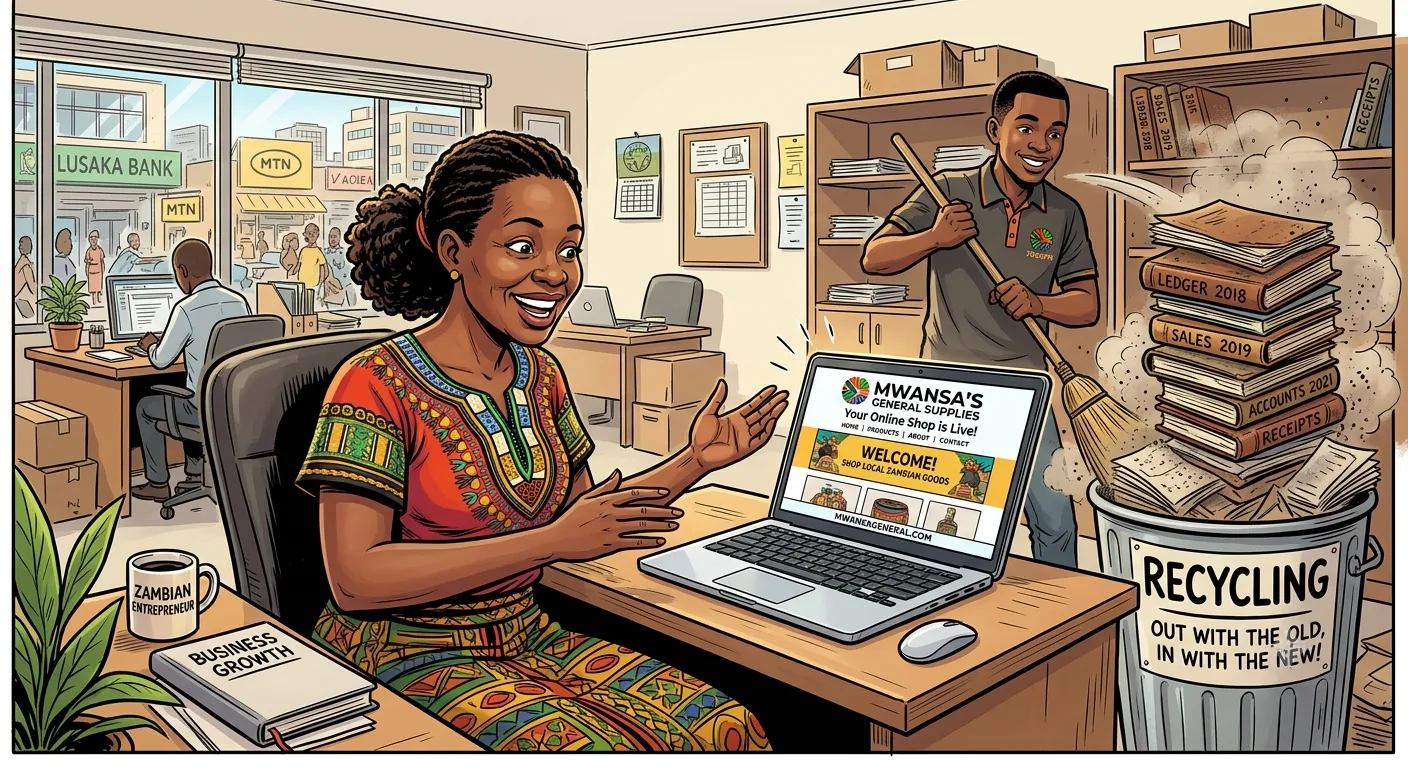
But it’s 2026. If your business doesn't have a solid digital footprint, you practically don't exist. When customers in Lusaka, Ndola, or Livingstone want to find a service, they don’t walk down Cairo Road looking at shop signs anymore. They open Google.
If they search for what you sell and your business doesn't show up, who gets the money? Your competitor—the one who invested in professional web development services in Zambia. This guide is your ultimate roadmap to understanding website development, how it works, what it costs locally, and how to get a site that actually brings in mula (money) instead of just sitting on the internet gathering digital dust.
What is Web Development, Really? (No, It’s Not Just "Typing Fast")
To the untrained eye, a web developer in Lusaka looks like someone who drinks too much mojo (energy drink), stares at a screen full of colorful text, and types at lightning speed. Some people think it’s just magic. Others think it’s a simple drag-and-drop job that their nephew who "studies IT" at the local college can do over a weekend for the price of a hungry lion meal.
Let’s break it down properly. Web development is the behind-the-scenes work that goes into building a website for the internet. It ranges from developing a simple, single static page of plain text to complex web applications, electronic businesses, and social network services. It is generally split into three main categories:
Front-End Development (The "Face")
This is everything the user sees, clicks, and interacts with. If you visit an online store and love the sleek animations, the neat layout of the products, and the way the checkout button pulses gently to beg you to buy, you are looking at front-end development. It's built using languages like HTML, CSS, and JavaScript.
Back-End Development (The "Engine")
If front-end is the shiny body of a Toyota Prado, back-end is the engine underneath the hood. It deals with servers, databases, and application logic. When a customer fills out a booking form on your site, the back-end is what processes that data, stores it securely, and sends you an email notification. Without back-end development, your website is just a pretty picture that doesn't do anything when you click it.
Full-Stack Development (The "All-Rounder")
A full-stack developer is someone who can comfortably handle both the front-end and the back-end. They are the ultimate utility players of the digital world—kind of like that one relative who can fix the plumbing, repair the car, and somehow negotiate down the price of building materials all at once.
Why Every Zambian Business Needs a Website
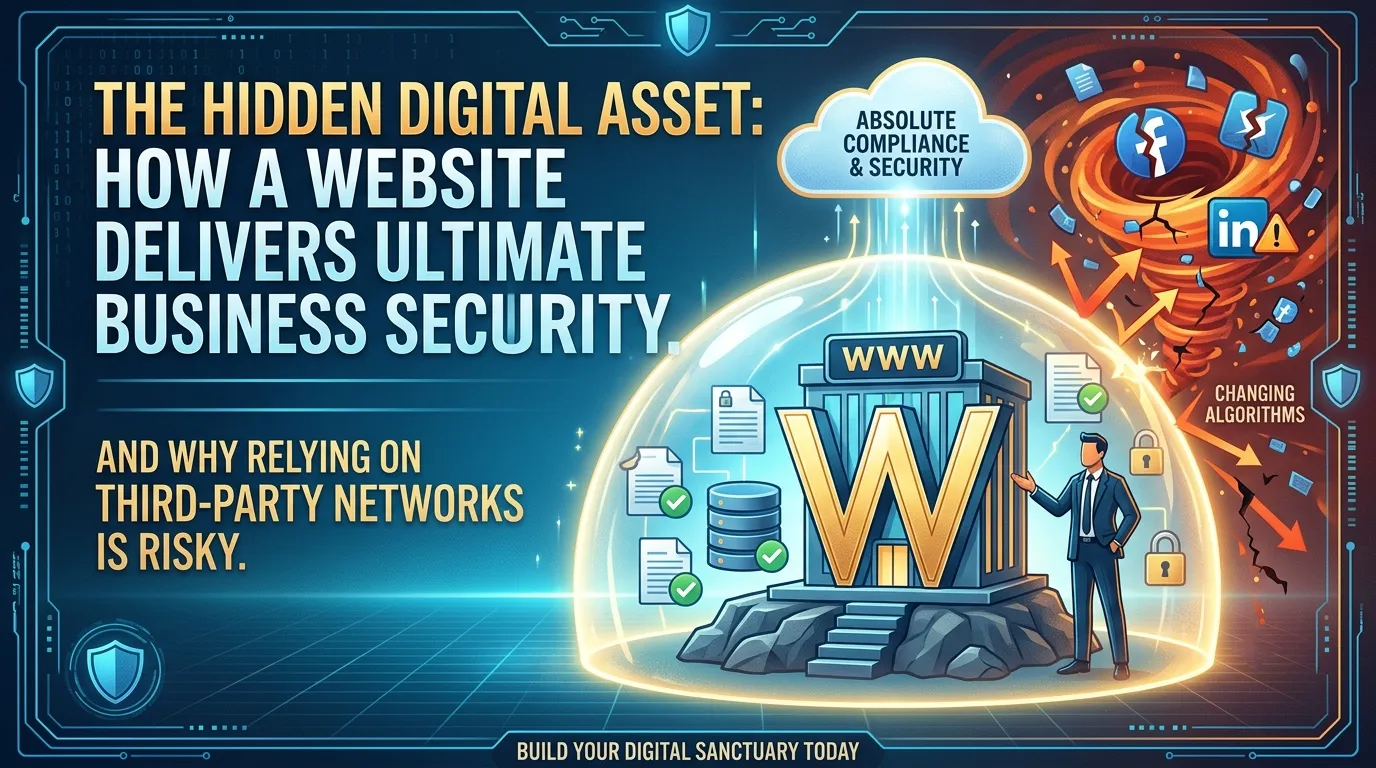
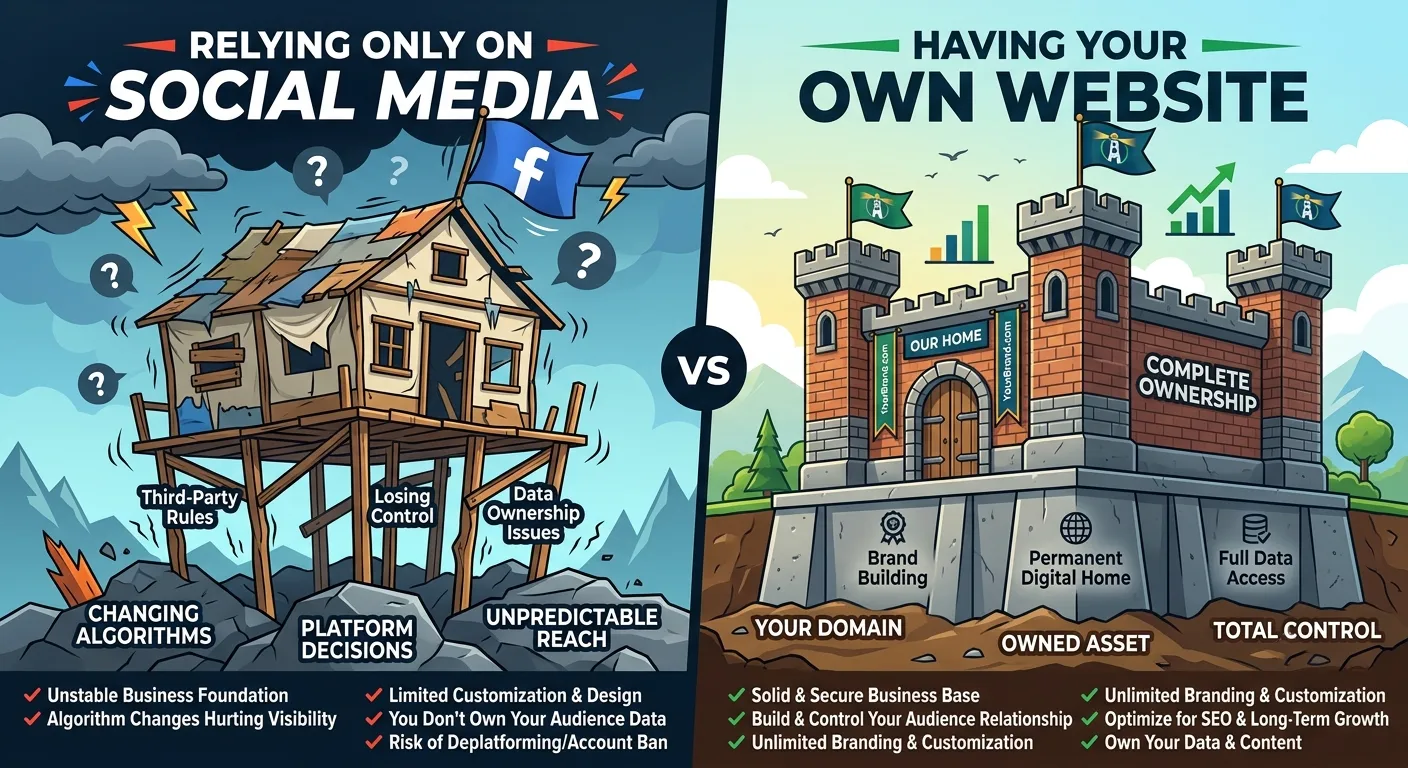
"But my Facebook page has 10,000 likes! Why should I spend money on a website?" We hear this question a lot. It’s a fair point—social media is great. But relying solely on Facebook or Instagram to run your business is like building a beautiful house on a piece of land you don't own. (Not sure if your current setup is working? Check out these 10 Signs Your Business Needs a New Website).
Here is why your Zambian business desperately needs its own home on the web:
You Own Your Platform
What happens if Facebook decides to lock your account tomorrow because of a glitch in their algorithm? Or what if the platform goes down during peak business hours? With a custom website, you own the domain name and the hosting. Nobody can shut you down because they changed their terms of service.
Professional Credibility
Let’s face it. If a customer is about to spend K50,000 on engineering services, solar installations, or corporate logistics, they want to know you are legitimate. A professional website sends a message: "We are a real, structured business, not a fly-by-night operation run from a car boot."
24/7 Availability (Even During Load Shedding!)
Even when your physical shop is closed, or when the power grid goes down in your residential area, your website stays live on secure cloud servers. Customers can browse your catalog, read your FAQs, and submit inquiries at 3 AM while you are fast asleep.
Google Search Traffic
When people are ready to buy, they don't search social media; they search Google. If you offer responsive web design or logistics services, ranking on Google search results gets you high-quality leads who are actively looking to spend money right now.
Website Design vs. Web Development: What’s the Difference?
Feature | Website Design | Web Development |
|---|---|---|
Primary Focus | Aesthetics, user experience, layout, and visual branding. | Functionality, database integration, security, and coding. |
Tools Used | Figma, Adobe XD, Photoshop, Illustrator. | VS Code, PHP, JavaScript, Python, SQL, Git. |
Analogy | The Architect who draws the beautiful plan of your house, choosing the paint colors and tile designs. | The Builder/Engineer who lays the bricks, connects the plumbing, and ensures the roof doesn’t collapse when it rains heavily in November. |
While a designer makes sure your website looks stunning and reflects your brand identity, the developer ensures that the site actually loads quickly, processes transactions safely, and works flawlessly across all devices. For a truly successful online presence, you need both website design Zambia and strong engineering.
Learn more about how these two roles work together in our detailed guide: Website Design vs. Web Development: What's the Difference?
Types of Websites You Can Build
Not all websites are created equal. The type of website you need depends entirely on what your business does and what you want your visitors to achieve.
Static/Informational Brochure Websites
These are simple, elegant sites designed to give users information about your business. They usually feature an "About Us," "Our Services," "Gallery," and "Contact" page.
Best for: Consultants, law firms, local clinics, and small trade businesses.
E-commerce Websites
An ecommerce website Zambia is a fully functional digital shop. It allows customers to browse products, add them to a cart, and pay directly using local payment gateways like Mobile Money (Airtel, MTN, Zamtel) or Visa/Mastercard.
Best for: Retail shops, boutique fashion brands, electronics sellers, and supermarkets looking to offer home delivery.
Dynamic Web Applications and Custom Software
Sometimes, standard templates won't cut it. You might need a custom portal where users can log in, track their shipping cargo, manage their staff payroll, or book a specific medical slot. This requires custom software development built from scratch.
Best for: Logistics companies, financial institutions, and tech startups.
Content Management Systems (CMS) / WordPress
WordPress powers over 40% of the internet. A CMS allows you to easily update your own blog posts, change images, and edit text without needing to write a single line of code.
Best for: Blogs, news sites, and businesses that want to manage their own content updates post-launch.
How to Choose a Web Developer in Zambia (And Avoid "My Nephew" Syndrome)
We have all been there. You want a website, and someone tells you, "Ah, my cousin's son, Junior, finished Grade 12 last year and is very good with computers. He can do it for K500." Three months later, Junior has stopped picking up your calls, your domain name is registered under his personal email (which you can't access), and your website homepage just says "Under Construction" with an ugly, pixelated logo.
To avoid tears and high blood pressure, follow this checklist when choosing a professional web developer in Lusaka or anywhere else in Zambia:
Look at their portfolio: Don't just look at screenshots. Ask for live links to websites they have built. Open those sites on your phone and see if they load fast and look good.
Ask about mobile responsiveness: Over 80% of Zambian internet users browse the web on their smartphones. If a developer builds a site that only looks good on a wide desktop screen, run away. You need responsive web design.
Who owns the domain and hosting? Ensure that the domain name (e.g.,
yourbusiness.comoryourbusiness.co.zm) and the hosting account are registered in your business's name, not the developer’s personal account.Ask about post-launch support: A website is like a car—it needs regular oil changes and maintenance. Ensure they offer support plans to keep your site updated and secure against hackers.
To ensure you are hiring a true professional and not a fly-by-night operator, check out our comprehensive checklist on How to Choose the Right Web Development Company in Zambia.
What Does Website Development Cost in Zambia?
Let's address the elephant in the room: How much does this actually cost? Because there is no official price control board for digital services, you will receive quotes ranging from K1,500 to K150,000 for the exact same project description. Here is a realistic breakdown of what you can expect to pay in the Zambian market for professional work:
Basic Brochure Website (3-5 pages): K5,000 – K15,000. Ideal for small local service providers.
Corporate Website (Multi-page with CMS): K15,000 – K35,000. Ideal for established companies, NGOs, and professional service firms.
E-commerce Platform (with Mobile Money/Card Integration): K25,000 – K60,000+. Depends on the number of products and inventory systems.
Custom Software & Large Portals: K80,000+. Built using customized frameworks for unique, highly scalable business operations.
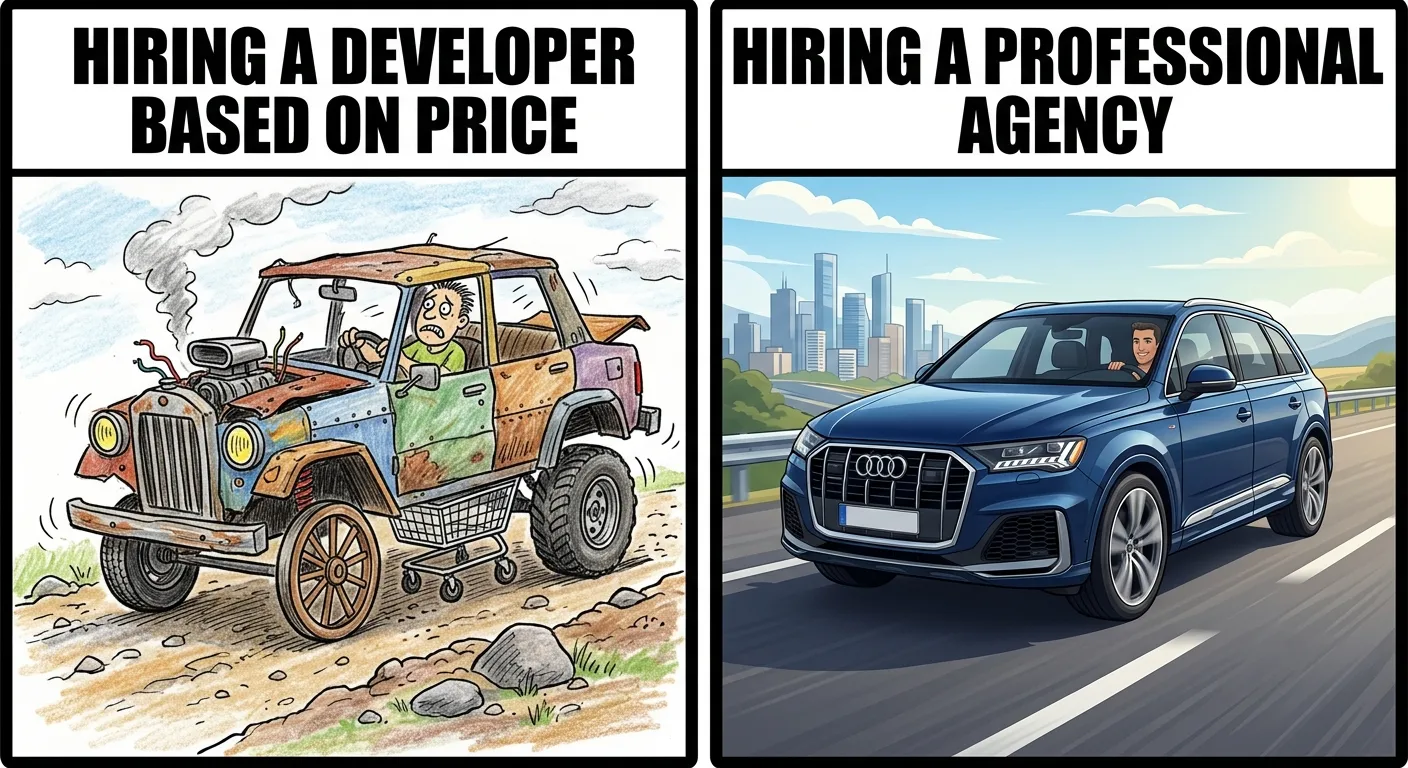
Remember: in web development, you get what you pay for. A cheap website that constantly breaks, displays errors to your clients, or gets hacked is far more expensive in the long run than paying a professional to do it right the first time.
If you want a deeper dive into exact pricing structures, hidden fees, and why 'Junior' charges K1,500, read our full breakdown on How Much Website Development Costs in Zambia.
SEO and Performance: Getting Found on Google
Having a beautiful website that no one can find is like printing a thousand flyers and keeping them locked inside your office drawer.
This is where Search Engine Optimization (SEO) comes in. To get organic, free traffic from people searching for your services, your developer must implement professional SEO services Zambia.
If you want to learn how to dominate local search, read our complete guide to SEO for Small Businesses in Zambia.
Mobile-First Indexing
Google ranks websites based on how well they perform on mobile phones. Your site must be lightning-fast, easy to navigate with a thumb, and perfectly adapted to mobile screens.
Local SEO
If you operate in Lusaka, your website should be optimized for searches like "best plumber in Lusaka" or "commercial lawyers in Zambia". This includes setting up your Google Business Profile and using local keywords naturally in your content.
Page Speed Optimization
Zambian internet speeds can vary wildly depending on whether your visitor is on a fast fiber connection or trying to load your page on 3G while traveling on the Great North Road. Your website's images must be compressed, and its code optimized, so it loads in under 3 seconds on any connection.
Keeping It Safe: Website Maintenance & Security
Hackers do not care if you are a small startup or a massive multinational. They use automated bots that scan the internet looking for weak, outdated websites to inject with spam, malware, or ransomware.
To keep your investment secure, your website needs constant care:
Regular Backups: What happens if something goes wrong during an update? You must have daily or weekly backups stored in a secure cloud location so you can restore your site with a single click.
SSL Certificates: An SSL certificate encrypts the data passing between your user and your website. It is what gives you that little padlock icon next to your URL. If you don't have one, Google will label your site as "Not Secure," which scares away customers faster than a guard dog.
Plugin and Theme Updates: If your site runs on WordPress, those plugins need regular updates. Outdated plugins are the number one gateway for security breaches.
Frequently Asked Questions (FAQs)
Q1: How long does it take to build a website in Zambia?
For a standard informational brochure site, it typically takes 2 to 4 weeks. For complex e-commerce platforms or custom software, it can take anywhere from 6 to 12 weeks depending on the scope of work and how quickly you provide the content (logos, text, photos) to your developer.
Q2: Can I accept Mobile Money payments on my website?
Yes, absolutely! We integrate local payment gateways (like DPO, Flutterwave, or Kazang) that allow your customers to pay directly using MTN Mobile Money, Airtel Money, Zamtel, or local and international credit/debit cards.
Q3: Do I need to buy my own domain name and hosting?
Yes. To have a live website, you must pay an annual fee for your domain name (the address, e.g., mybusiness.com) and your hosting (the digital space where your site's files live). Your developer can set this up for you, but make sure the accounts are in your name.
Q4: Can I update the website myself once it's finished?
Yes, if your website is built on a Content Management System like WordPress. A professional developer will provide you with a basic training session to show you how to upload new blogs, change prices, and update your contact details easily.
Ready to Dominate the Zambian Digital Space?
Don't let your competitors take all the online leads while you rely on old-school marketing. It's time to build a high-performing digital platform that works as hard as you do.
Whether you need a sleek corporate website, a bustling e-commerce store, or custom software to streamline your operations, we are here to bring your vision to life.
Contact Us Today for a Free Web Consultation & Quote! Let's get your business online.