Every business owner in Zambia eventually reaches the same moment. A customer says, "Do you have a website?" and you reply with the confidence of a man who has just been asked to dance at a wedding: "Yes, yes, we are working on it."
That sentence has been "in progress" for years in some offices. This guide exists to end it.
There is no shortage of advice on the internet about websites. What is rarer is a map: one that shows how the whole journey fits together, from the first idea to the first sale, with Zambian roads, Zambian data bundles, and Zambian customers in mind. Think of this article as that map. Where a particular road deserves its own detailed guide, I'll point you to it. But the route itself, the order of decisions, and the traps along the way are all right here.
Let's start with the question nobody asks first: who will actually build this thing?
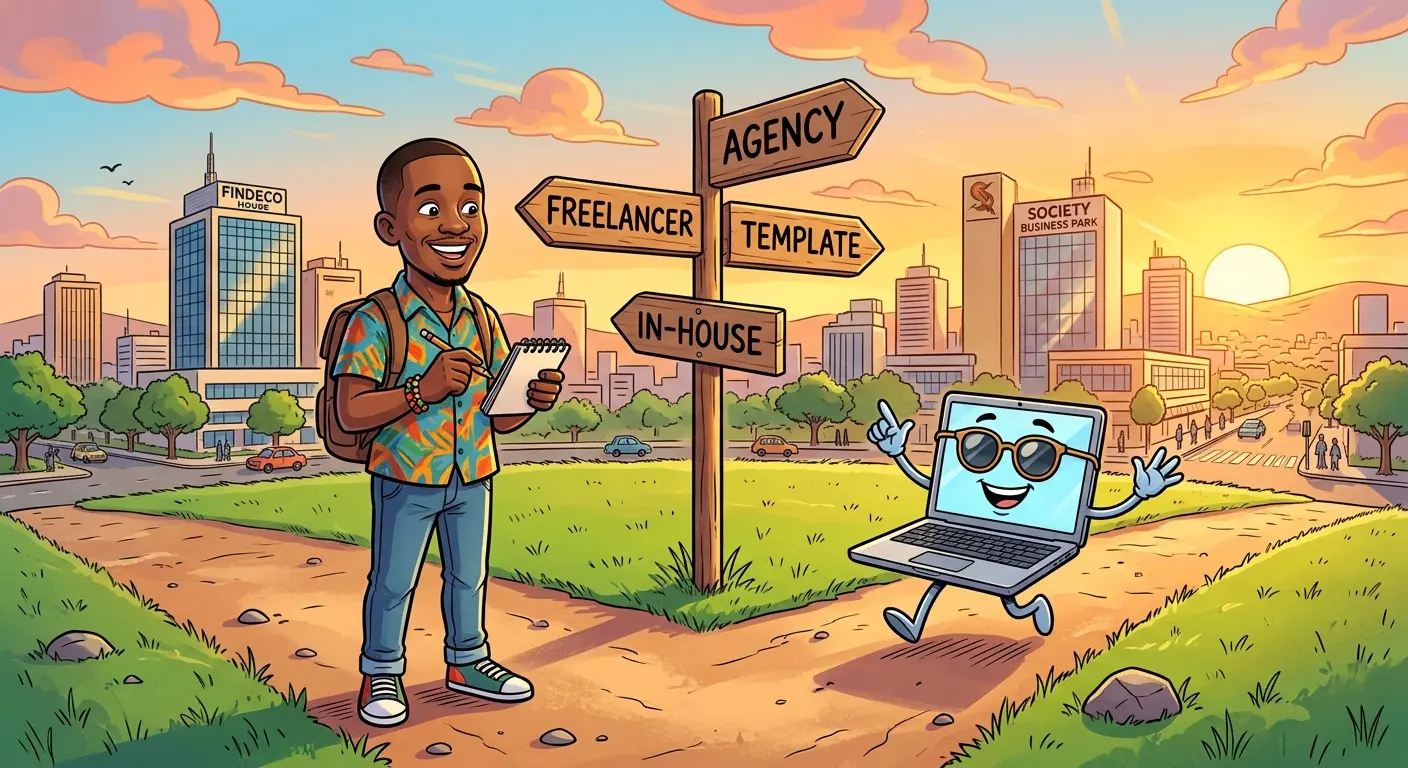
Who Builds Websites in Zambia? Meet the Four Species
Before you talk about code, colors, or cost, you need to understand who is on the market. In practice, you will meet four types of builders, and each behaves very differently.
Builder type | Typical strength | Typical weakness | Best fit |
|---|---|---|---|
Freelance developer | Flexible, personal, often affordable | One person means one point of failure (and one phone that might be off) | Small sites with a clear scope |
Web development agency | Full team: design, code, SEO, support | Higher fees, more formal process | Growing companies, e-commerce, custom systems |
DIY website builder | Fast, cheap to start | Limited control, generic look, hard to scale | Testing an idea or a side hustle |
In-house developer | Always available, knows your business | Salary, management, and one more person on payroll | Large organizations with constant digital work |
None of these is "best." Each is best for a situation. A tailor can make you a beautiful suit, but you wouldn't ask him to build your house. The mistake most businesses make is picking the builder before defining the job.
When you reach the stage of comparing actual companies, my checklist on how to choose the right web development company in Zambia walks you through the vetting questions. For now, hold this thought: the job comes first, the builder second.
Six Zambian Realities That Should Shape Every Website
A website built for a business in London and a website built for a business in Lusaka can look identical on screen and perform very differently in real life. Here are the local factors that decide whether yours succeeds.
1. Your customer is probably on a phone, paying for data
In Zambia, a visitor loading your homepage may be spending real money on every megabyte. A site stuffed with giant photos and auto-playing videos is basically charging your customer a toll to enter your shop. Lean pages, compressed images, and clear layouts are not a design preference here; they are good manners.
2. Mobile money is the till
If your customers pay with Airtel, MTN, or Zamtel mobile money, your website should meet them there. A checkout that only accepts international cards will politely lose a large part of your market. Ask any developer you interview which local payment gateways they have actually integrated, and ask to see them working.
3. WhatsApp is your front desk
Zambians run conversations, quotes, and orders through WhatsApp. A smart website does not fight this habit; it feeds it. A visible WhatsApp button, a pre-filled message such as "Hi, I'd like a quote for...", and a clean phone number turn a visitor into a conversation in one tap.
4. Power and connectivity are not guaranteed
Load shedding and patchy networks are part of life. Your website should be hosted on reliable cloud servers rather than a machine in someone's back room, and it should degrade gracefully on a weak signal. Nobody enjoys a page that shows a blank screen for twenty seconds and then gives up.
5. Domains and hosting deserve a local-aware decision
You will choose between a global extension like .com and a local one like .co.zm. Local extensions signal "we are based here," which can reassure local buyers, while .com suits businesses that plan to sell beyond Zambia. Whichever you choose, register it in your business name and keep the login details somewhere safer than a sticky note.
6. Trust is built differently here
Many customers want proof that a real business sits behind the screen. A physical address, a working phone number, photos of your actual premises, and recognizable client names do more for conversions than any fancy animation.

Match the Website to Your Business Stage
Here is a mistake that costs businesses real money: buying a Ferrari when what you need is a bicycle with a good basket. Let me suggest a simpler way to decide, based on where your business stands today.
Stage 1: Just getting started. You need credibility fast. A clean, small website with your services, a few photos, contact details, and a WhatsApp button will do the job. Keep it lean, and grow it when the money comes in.
Stage 2: Growing steadily. Your customers now compare you with competitors online. You need a multi-page site with a content management system, a blog, service pages optimized for search, and lead capture forms. This is the stage where most Zambian small businesses should be investing.
Stage 3: Scaling up. You are processing orders, bookings, or staff workflows at volume. Time to think about e-commerce, customer portals, or custom software that connects to your operations.
Not sure which stage you are in? Look at what your current site (or lack of one) is costing you. My list of 10 signs your business needs a new website is a good diagnostic. And once you know what you are building, the 10 non-negotiable features every small business website in Zambia must have is a handy shopping list to bring to your first meeting.
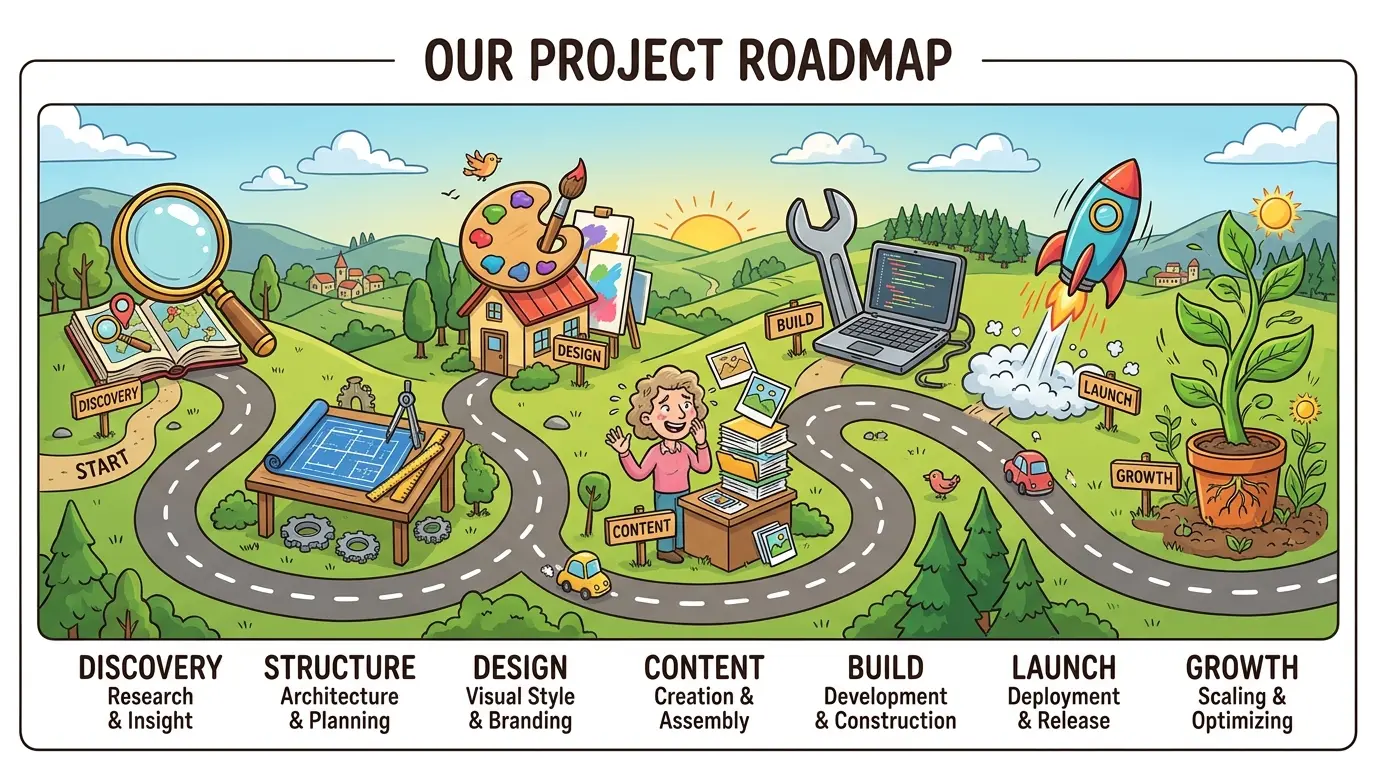
The Seven Stages of a Website Project (and Where You Come In)
Most people imagine a website project as: "I pay, the developer disappears into a cave, and a website emerges." Sadly, caves do not work that way. A website is built in stages, and you are responsible for more of them than you think.
Stage 1: Discovery. The developer asks about your customers, goals, and competitors. Your job is to answer honestly. "We want to be the best" is a sentiment, not a goal. "We want 20 quote requests per month" is a goal.
Stage 2: Structure. This is the blueprint: which pages exist, how visitors move between them, and where the buttons live. Skipping it is like pouring concrete before drawing the house plan.
Stage 3: Design. Colors, fonts, imagery, and layout come together. If you are curious who does what here, my explainer on website design vs web development clears up the difference between the architect and the builder.
Stage 4: Content. Here is the secret that delays more projects than any technical problem: the content is almost always late, and it is almost always the client's job. Logos, photos, service descriptions, and testimonials do not write themselves. If your developer is waiting for your text, your website is waiting for you.
Stage 5: Build and testing. The developer turns the design into a working site and tests it on different phones, browsers, and connection speeds. This is the moment to click every button yourself, even the ones you assume are fine.
Stage 6: Launch. Domain connected, security certificate active, analytics running, and a backup plan in place. A good launch is boring. If your launch day is exciting, something went wrong.
Stage 7: Growth. A website is not a poster you put up once. It needs fresh content, performance checks, and security updates. Businesses that treat launch day as the finish line usually come back a year later with a stale site and a sad face.
Budget Like an Owner, Not a Bargain Hunter
Everyone asks, "How much will it cost?" A better question is, "What will it cost me over three years, and what will it earn?"
The sticker price is only one part of the picture. A realistic budget has four layers:
Build cost: the one-time fee for design and development.
Running costs: domain renewal, hosting, email, and security certificates every year.
Care costs: updates, backups, and small edits after launch.
Growth costs: content, SEO, and advertising that bring visitors in.
Now a quick, purely illustrative bit of arithmetic. Suppose an average customer is worth K2,000 to your business, and your new website brings you just five extra customers a month. That is K10,000 in new revenue every month, or K120,000 a year. Even a modest website can pay for itself quickly when it is built to convert. Meanwhile, a cheap site that nobody trusts earns exactly nothing, no matter how little it cost.
Prices vary widely depending on scope, and the exact figures depend on what you need. If you want to see the ranges, the hidden extras, and the reasons for those wildly different quotes, my detailed guide on how much website development costs in Zambia breaks it all down. And if you already have a site that feels slow, you might be surprised how much can improve without spending much at all; see how a $0 website overhaul cut load times by 80%.
Put It in Writing: Seven Clauses Worth Having
Whether you hire a freelancer or an agency, a clear agreement protects both sides. You don't need a thirty-page legal document, but you do want these seven points spelled out:
Scope: exactly which pages and features are included.
Timeline: key milestones, and what happens if either side runs late.
Payment schedule: usually split across milestones rather than paid all at once.
Revisions: how many rounds of changes are included.
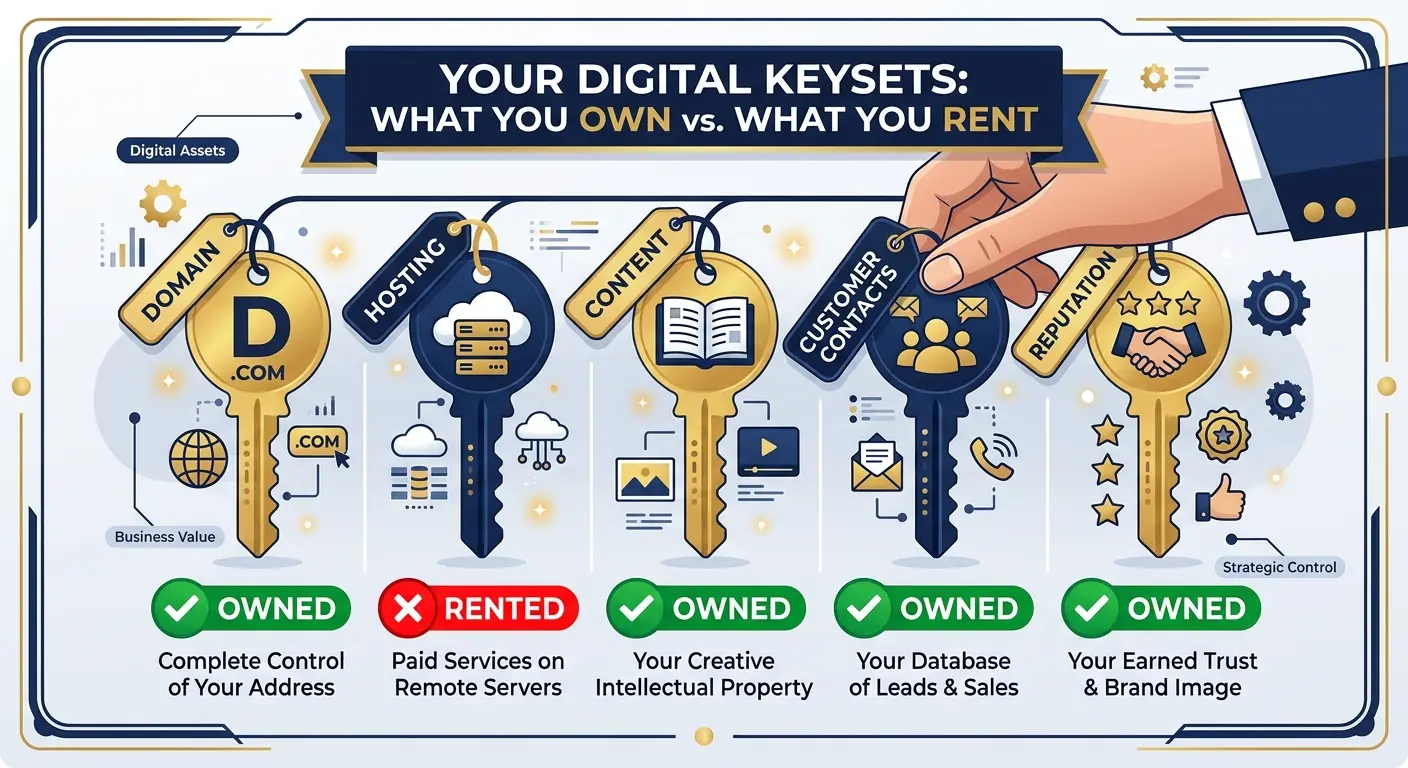
Ownership: the domain, hosting, design files, and code belong to you after final payment.
Handover: logins, documentation, and a short training session so you can update your own content.
Support: what happens after launch, for how long, and at what cost.
If a developer gets uncomfortable when you ask for these, you have just learned something valuable at a very cheap price.
After Launch: The Growth Loop
A launched website is a shop that has opened its doors. Customers still need to find the street.
The growth loop has three parts: get found, convert visitors, and stay safe.
Get found. Search engine optimization helps people discover you when they search for what you sell. Start with your Google Business Profile, local keywords, and useful content. My beginner's guide to SEO for small businesses in Zambia covers the steps in plain language.
Convert visitors. Look at where people drop off and fix those pages. Clearer headlines, faster loading, and one obvious next step usually beat a redesign.
Stay safe. Backups, updates, and security certificates are the seat belts of the internet. You won't notice them until you need them. For a closer look at why your website is also one of your most valuable business assets, read how a website delivers ultimate business security.
Five Expensive Mistakes (Learn From Other People's Pain)
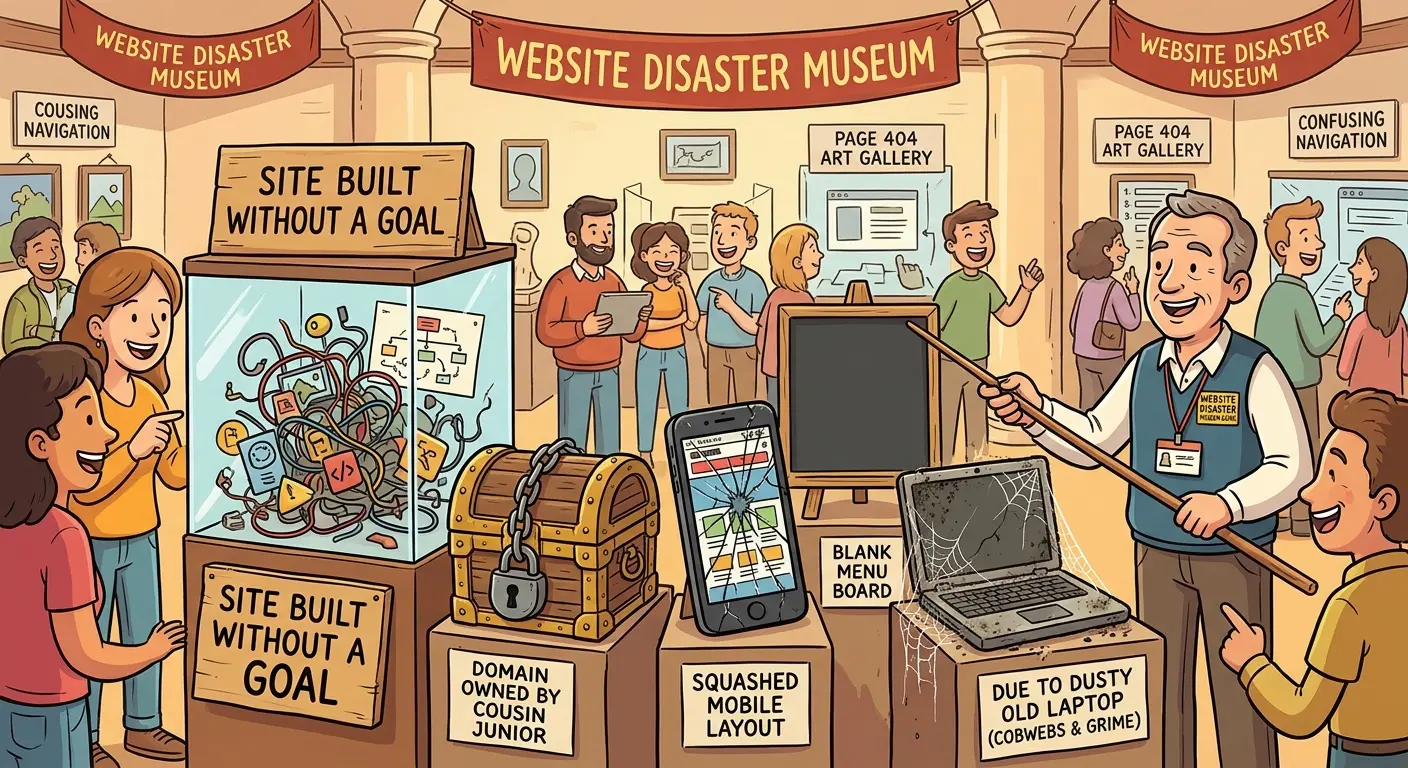
Building before deciding. Without a goal, a website is a very expensive brochure.
Letting the developer own everything. Always register your own domain and hosting.
Ignoring the phone. Test your site on a mid-range smartphone, not just your office computer.
Forgetting the content. A beautiful website with placeholder text is like a restaurant with no menu.
Disappearing after launch. No updates, no backups, no growth. The internet notices.
Your 90-Day Launch Plan
If you want to move from "we are working on it" to "visit our website," here is a realistic plan.
Days 1 to 15: Decide. Define your goal, choose your website stage, list your must-have features, and set a budget range. Gather examples of sites you like and sites you hate.
Days 16 to 30: Choose. Shortlist two or three builders, ask for live examples and written quotes, and sign an agreement that covers the seven clauses above.
Days 31 to 60: Build. Approve the structure and design quickly, and deliver your content on time. Review the test version on your own phone.
Days 61 to 75: Launch. Final checks, domain connection, security certificate, analytics, and a launch announcement on your social channels and WhatsApp status.
Days 76 to 90: Grow. Publish your first helpful blog posts, set up your Google Business Profile, and review your first month of visitor data.
Questions People Rarely Ask (But Should)
I already have a WhatsApp Business account. Do I still need a website? Yes. WhatsApp is excellent for conversations, but a website is where new customers discover you, judge you, and decide to start that conversation in the first place. The two work best together.
Can I start with a one-page website and expand later? Absolutely. A well-built single page with your services, proof, and contact options is far better than waiting a year for the perfect website. Just make sure it is built on a foundation that allows you to add pages later.
Template or custom: which should I pick? Templates are faster and cheaper to start, while custom work gives you control, a unique look, and room to grow. If your business depends on a special process, or you plan to scale, custom usually pays off.
Who should write my website content? You know your business best, so your input is essential. A professional writer or your developer can polish the text, but the facts, stories, and photos must come from you.
Ready to Put Your Business on the Map?
A website won't fix a business with no customers or a product nobody wants. But for a business that is good at what it does, it is the loudest, most reliable, always-open salesperson you can hire, and it never asks for a day off.
If you would like a clear plan for your own project, explore the benefits a professional website can bring to your business, then book a free web consultation and quote. Let's turn "we are working on it" into "here is the link."